
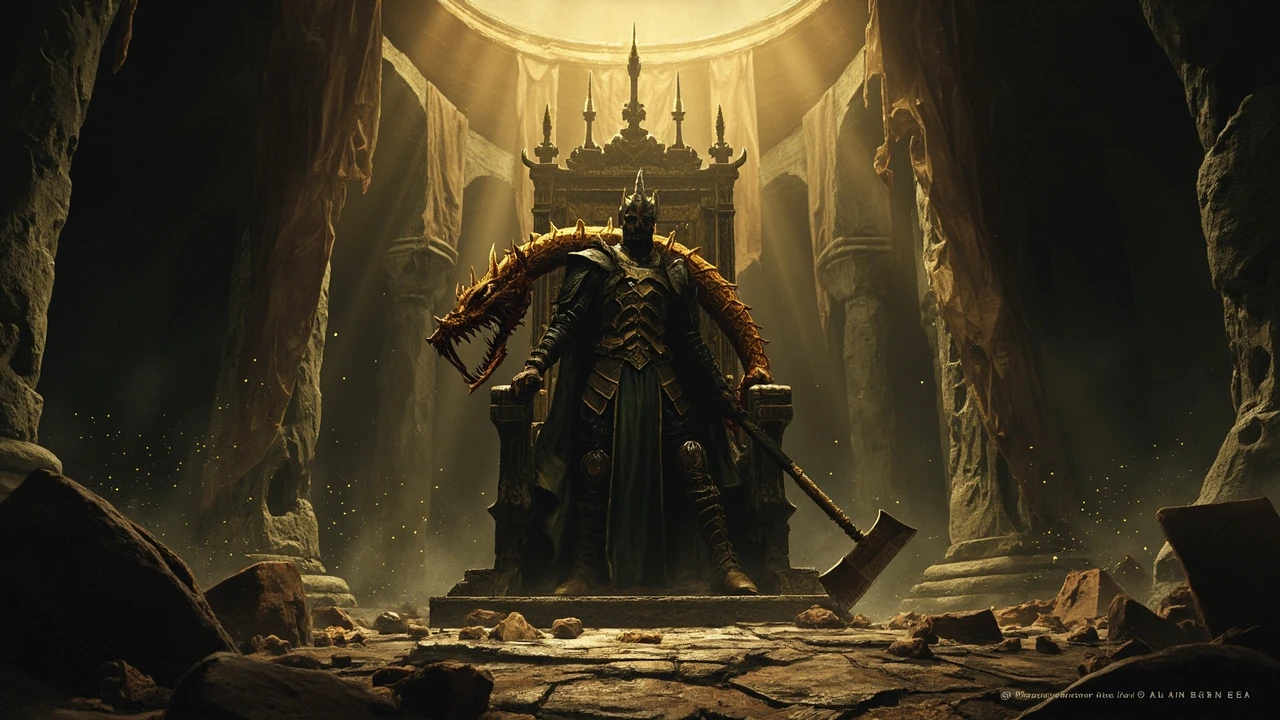
Godrick the Grafted: how FromSoftware designs a first “great” enemy
Godrick the Grafted is the first Shardbearer most players meet in Elden Ring. He waits at the end of Stormveil Castle, and on a standard first run he is the first time a player has to read a long combo, manage a phase transition, and decide whether to spend a summon sign. For a designer or technical artist, he is also a compact case study in encounter pacing: a slow, telegraphed first phase, a visible body-horror transformation at half health, and a second phase that reuses the same arena while reshaping the threat model. This breakdown looks at the encounter the way a development team would, separating the boss from the surrounding level, the animation data that drives each move, and the player decisions that gate the kill.
The aim is to treat Godrick the Grafted as a piece of shipped content and ask the questions a developer would ask when reviewing the work: what is the encounter actually testing, what data is being driven, and where do the design choices create predictable failure modes that players learn to compensate for.
Where Godrick the Grafted sits in the game’s content graph
FromSoftware’s open-world structure for Elden Ring places a “main” legacy dungeon in each major region. Stormveil is the first of those for most players who follow the natural path from the Stranded Graveyard through Limgrave. Godrick is the boss that closes that dungeon, which puts him in a specific position: he is simultaneously a required story encounter and a skill gate. Players cannot finish the main campaign without defeating him, but the game never explicitly tells them that he is the first of the Shardbearers or that he holds one of the Great Runes needed to enter the capital.
For developers, that placement matters because it shapes the budget for the encounter. A mandatory first-legacy boss has to be:
- Survivable by a wide range of builds, including players who have invested mostly in vigor with minimal dexterity.
- Readable enough that pattern recognition is a reliable skill, not a reflex test.
- Recoverable after multiple deaths, with a forgiving shortcut back to the boss fog.
- Visually distinct, so it can be marketed in trailers and remembered by players who never read patch notes.
Godrick the Grafted satisfies all four. His first-phase walk speed is slow, his wind-ups are long, and his arena is small enough that a player can roll away from a committed attack and still have time to reposition. That design envelope is what makes him feel fair in a genre where players expect mandatory bosses to be punishing.
Encounter structure: the Stormveil boss arena as a level-design object
The arena is a roughly circular chamber with a raised central platform and broken architecture around the rim. For level designers, the room is doing several jobs at once:
- It frames the camera against a flat back wall so the player can keep Godrick the Grafted in view even when his model is partially obscured by the dragon head during phase two.
- It provides verticality through small steps and a higher ledge that the camera can pan over without losing the boss.
- It is small enough to encourage melee engagement but large enough that a ranged caster with a summon can find angles without immediately leaving the lock-on range.
The Site of Grace is placed just outside the fog wall, and the boss can be re-engaged quickly after death. That is a deliberate production decision: the development team wanted the boss to be a learning loop, not a traversal tax. A player who dies five times should still be able to spend the sixth attempt entirely on reading telegraphs rather than re-walking a long dungeon.
From a streaming and recording standpoint the room is also friendly. There are few light sources that can blow out a capture, no transparent volumes that interfere with depth-of-field, and the floor texture holds up under aggressive post-processing. None of that is a gameplay concern, but it explains why so many Elden Ring highlight clips of first-time clears are framed in this exact chamber.
Phase one: the axe-and-roll model
In his opening form, Godrick the Grafted fights with a large axe in his right hand and a grafted arm in his left. The combat model is built around a small set of committed animations:
- A horizontal axe swipe that ends in a short recovery.
- A two-handed overhead slam with long wind-up and clear footwork.
- A charging thrust that closes distance quickly.
- A short stomping combo that finishes with a follow-up swing.
Each of these is engineered with a visible tell: the axe raises before the overhead, the model leans before the thrust, and the recovery animation leaves a window where a heavy attack will land. The slow base movement speed gives players time to choose between dodging, blocking, or trading with a fast weapon. This is the core “learn the pattern” loop that the encounter depends on, and it is also the reason a disciplined first-phase player can defeat Godrick the Grafted without ever seeing the second phase if their damage output is high enough.
How the animation budget shows up in the data
From a technical perspective, each of those attacks is a separate animation clip with its own hitbox frames, recovery frames, and damage values. Designers who want to study encounters like this in their own work can break the fight down the same way a frame-data community does:
- Startup frames: the time from the start of the wind-up to the first active hitbox.
- Active frames: the window in which the hitbox can deal damage.
- Recovery frames: the time after the last active frame before the boss returns to a neutral state.
- Stance damage: how much posture or poise the attack removes from a blocking target.
Godrick the Grafted’s attacks in phase one sit firmly in the “long startup, long recovery” category. That is not an accident. Players need long recoveries to be rewarded for committing to a dodge or parry; without them, every fight turns into a coin flip where the only winning move is to never engage.
A second data point worth flagging is hitbox generosity. Godrick’s horizontal swipe hits slightly behind the arc of the visible blade, which is a common FromSoftware technique to make an attack feel weighty without punishing players who read the animation correctly. Designers borrowing this pattern should be aware that the generosity has to be tuned per move; an over-generous hitbox on a fast follow-up swing can make the fight feel unfair in the other direction.
Phase two: the dragon-head transformation as a threat-model reset
At roughly half health, Godrick the Grafted performs a long, staged animation in which he grafts a severed dragon head onto his left arm and then breathes fire. The cutscene is more than a visual flourish. It is a contract with the player that the rules of the fight are about to change. From the moment the dragon head is attached, the encounter shifts from a pure melee pattern read to a layered threat that includes:
- Fire damage on existing moves, including the overhead slam and several slashes.
- A dedicated fire breath with a wide arc that punishes players who stand directly in front of him.
- A grabbing attack in which he bites the player, deals heavy damage, and heals himself for a portion of the damage dealt.
For developers, the self-heal is the most interesting data point in the phase transition. It is a soft timer: even if a player is doing everything else right, a single mistake that lands the bite attack can erase minutes of progress. That single mechanic turns the second half of the fight into a punishment for overcommitting to offense, which is the kind of soft constraint the rest of the game’s boss design leans on heavily.
Why the dragon head is grafted, not worn
The narrative decision to graft rather than wear a dragon has mechanical consequences. A full dragon would require a separate rig, separate hitbox data, and a different collision profile. Grafting a head onto an existing arm keeps the boss on the same skeleton, the same animation driver, and the same collision volume, which is the cheaper path through production. The visual storytelling and the production economy line up: the player reads “this is body horror” and the developer reads “this is the same rig with an attached prop and a new VFX socket.”
That choice has a knock-on effect on the audio layer as well. Because the dragon head is a prop attached to the existing rig, its roars can reuse the same audio bank and the same attenuation curves as the rest of Godrick’s voice work, with a single additional layer for the fire breath. A separate dragon rig would have meant new spatialization rules, new occlusion checks against the arena geometry, and new mixing priorities against the music stem. Reusing the existing skeleton keeps the boss mixable on the same audio budget as a normal humanoid enemy.
The reward structure: Great Rune, Remembrance, and what they signal
Defeating Godrick the Grafted grants two items: Godrick’s Great Rune and the Remembrance of the Grafted. The Great Rune is the macro-level reward; it is one of the keys required to enter Leyndell, the royal capital. The Remembrance is the meta-level reward; it can be traded for a unique weapon or a unique ash of war at a roundtable vendor. Both are “spend once, keep the value” items, which means the encounter has to feel significant even on a second playthrough where the player already knows the patterns.
From a design standpoint, the reward structure has three properties worth noting:
- It is gated by progression, not by an optional quest. The player cannot skip Stormveil and still reach the capital.
- It is build-defining rather than build-replacing. The Great Rune is a stat modifier that any build can use, and the Remembrance weapons are competitive but not strictly best-in-slot.
- It is a one-time-per-playthrough reward, which preserves the encounter’s identity across New Game Plus runs.
There is a small but interesting economy decision in the Remembrance trade. Offering a weapon and an ash of war as the two options means the player can never get both from a single Remembrance, which preserves a reason to repeat the fight across multiple save files or characters. A design that handed out both items at once would lose that long-tail engagement loop.
Reading Godrick the Grafted as a difficulty curve
Across the full game, Godrick sits near the bottom of the Shardbearer difficulty stack. Rennala follows, then Radahn, then Morgott, and finally the endgame duo. The reason this ordering matters is that it gives the development team room to escalate without ever making a Shardbearer trivial. Each subsequent Shardbearer can introduce a new mechanic because Godrick has already established the baseline pattern: a slow, telegraphed first phase, a visible transformation, and a heal-on-hit punish in the second phase.
For developers, this is the design pattern of “tutorial by precedent.” The game never says “this is how a Shardbearer works.” Instead, it lets Godrick the Grafted teach the form, and then every later Shardbearer can spend its complexity budget on something new because the player has already absorbed the underlying contract.
One practical risk of that approach is that players who never struggled with Godrick may not realize the contract has changed by the time they reach Morgott. A team borrowing this structure for a smaller game can compensate with a single line of NPC dialogue, a loading-screen tip, or a brief change in arena lighting that signals a new rule set. Elden Ring largely trusts the player to read the visual cues, which is the right call for its audience and the wrong call for a more casual title.
Comparing Godrick the Grafted with the rest of the Shardbearer set
The table below is a high-level comparison based on the role each boss plays in the main story and the mechanics that define the fight. The intent is to highlight design decisions rather than rank the bosses by difficulty.
| Shardbearer | Approximate role | Signature mechanic | Recovery or self-heal | Phase change visual |
|---|---|---|---|---|
| Godrick the Grafted | First mandatory legacy boss | Dragon-head graft with fire damage | Bite attack heals a portion of damage | Body-horror graft of a dragon head |
| Rennala, Queen of the Full Moon | Second mandatory legacy boss | Summoning reborn scholars | Resurrection cycle in second phase | Transitions from dueling arena to moonlit library |
| Starscourge Radahn | Optional legacy boss with festival lead-in | Summonable NPC allies and gravity magic | None in the standard fight | Riding phase into a ground-based duel |
| Morgott, the Omen King | Capital gatekeeper | Holy damage and curse sword combos | None in the standard fight | Transformation into a more aggressive form |
The table is a working reference, not a tier list. Different builds will have different experiences of each row, and optional modifiers such as player-summoned NPCs change the data substantially. The point is that Godrick the Grafted is the only one of the set that introduces the “self-heal on hit” concept, which is why many players remember him as the fight where greed is punished.
What the encounter teaches a player about the rest of the game
Godrick the Grafted is, in a practical sense, the first exam in Elden Ring’s combat language. After the fight, a player has internalized several skills that the rest of the game assumes:
- Reading a long wind-up and choosing a dodge direction.
- Committing to one punish window rather than fishing for a second.
- Recognizing a phase transition and backing off until it completes.
- Understanding that the boss can recover health, which means overcommitting is its own kind of failure.
For a developer writing design documentation, those four bullets are the most important thing about the encounter. The animation work, the VFX, and the audio are all in service of those four learning goals. A boss that looks spectacular but does not teach a transferable skill is wasted budget in a long game.
Build-agnostic mechanics versus build-specific counters
A useful way to think about Godrick the Grafted is to separate the mechanics that work against every build from the mechanics that are primarily countered by a specific build archetype. The following table captures that split at a high level.
| Mechanic | Build-agnostic counter | Build-specific counter |
|---|---|---|
| Long startup on overhead slam | Roll into the swing or backward | Parry with a small or medium shield |
| Fire damage in phase two | Maintain fire resistance talisman or spell | Use a magic-resist shield or a faith build with fire defense |
| Bite attack with self-heal | Stay out of grab range and use a summon for aggro | Freeze or bleed proc to interrupt the bite wind-up |
| Erratic movement in tight combos | Back off and wait for recovery | Use a fast weapon with natural poise damage |
Reading the table from a developer perspective, the left column is the design intent. The right column is what the community has discovered. The fact that bleed and frost both work is not necessarily designed; it is the emergent result of how status effects are implemented in the underlying system. Designers who want to control that interaction would need a dedicated resistance stat on the boss, which Godrick the Grafted does not appear to have.
That lack of a dedicated resistance stat is itself a design choice. A first mandatory boss that hard-coded resistances would communicate a hidden rule to the player that the game never explains, which is the kind of opaque design that FromSoftware has historically tried to avoid in its flagship content. Easier to let bleed work, let frost work, and let the player pick whatever weapon they have already leveled.
Player summons and the encounter’s social layer
Players who want help against Godrick the Grafted can summon the NPC Nepheli Loux outside the boss door. She draws aggro, deals consistent damage, and buys time for the player to learn the telegraphs. The encounter is also one of the first places where the asynchronous multiplayer summons appear, which lets a player pull in another human for the fight. The IGN guide to the boss notes that Nepheli is available just outside the door and that her presence is enough to turn a struggling run into a comfortable clear for many players.
From a production standpoint, having a guaranteed NPC summon next to a mandatory boss is a deliberate quality-of-life choice. It gives players who are stuck a path forward that does not require them to grind levels or change their build. For developers, it is a reminder that “raise the damage numbers” is rarely the right answer to a difficulty problem; a small NPC interaction can do more for completion rate than any number tuning pass.
There is also a community effect. Players who summon Nepheli for the first time often see the same NPC die in one hit and feel responsible for the loss, which is a small but real emotional beat the game can lean on later. The investment the player makes in keeping summons alive in this fight pays off when they meet the same character elsewhere in the story.
How a developer would approach a post-mortem of the fight
If a development team were reviewing Godrick the Grafted as shipped content, the post-mortem would likely land on a few specific questions:
- Did the first phase prepare players for the second phase? The visible graft and the fire arc telegraph the new threat well, but the bite-and-heal still catches many players on the first run.
- Is the encounter tunable in isolation? Godrick the Grafted is one of the more frequently patched Shardbearers, and a single change to his damage values ripples into every other content balance decision.
- Are the rewards proportional to the time investment? The Great Rune is mandatory, but the Remembrance is build-defining rather than build-replacing, which keeps the economy stable.
- Does the arena support the camera? The room is small, flat, and has good back walls, which is why the fight is unusually readable on lower-end hardware.
Those questions are the same questions a studio would ask about any first-mandatory boss in an action RPG, which is why Godrick the Grafted is a useful reference even for teams working in a different genre or engine. The fight is small enough to study in a single sitting and complete enough to expose most of the moving parts a designer needs to think about.
One question a post-mortem would have to grapple with is whether the bite-and-heal is too punishing for the audience the game is trying to reach. Players who learn the phase transition quickly never see it as a problem. Players who are still parsing the fire arc and miss the new grab wind-up can lose a five-minute run in a single bite, which is a real cost in a session-based game. The studio’s answer, in practice, is to trust the player to retry and to keep the Site of Grace close enough that retrying is cheap.
What Godrick the Grafted does not test
It is worth being explicit about the limitations of the encounter as a learning tool:
- It does not heavily test stamina management, because the wind-ups are long enough that a single dodge restores a comfortable margin.
- It does not heavily test positioning across a wide arena, because the room is small and mostly flat.
- It does not test gear checks in the same way that later bosses do, because many players defeat him in starter equipment.
For a designer, those omissions are the most informative part of the case study. Godrick the Grafted is not a “complete” exam; he is a targeted one. He teaches pattern recognition, punish windows, and threat-model resets, and he leaves stamina, positioning, and gear checks for later bosses. That split is how a long game keeps its pacing curve alive without exhausting the player on the first mandatory fight.
It is also worth noting what the fight does not test about the player as a person. There is no morality check, no alignment flag, no NPC fate that hinges on whether the player summons help or goes in alone. The encounter is a pure mechanical test, and that purity is part of why it is such a reliable teaching tool. The first time the game asks the player to make a hard moral choice, it is not in a boss arena.
Implementation notes for developers studying the encounter
Developers who want to extract a reusable pattern from Godrick the Grafted can think of the fight as three separable layers:
- A base layer of committed animations that are always available.
- A phase-change layer that adds a new VFX socket, a new damage type, and a new behavior on existing animations.
- A self-heal layer that activates only in the second phase and only on a single attack, creating a localized failure mode rather than a global one.
Each layer is independently tunable. The first layer governs how readable the fight feels. The second governs how dramatic the transition is. The third governs how punishing mistakes are. Treating them as separate systems is what lets the encounter scale across the rest of the game, because a future Shardbearer can borrow any subset of the three layers without copying the whole fight.
A fourth layer that is easy to miss is the audio transition. The phase cutscene is accompanied by a music swell and a brief silence before the combat track resumes, which gives the player an audio cue to re-engage. Designers porting this pattern to a smaller project should keep that audio gap. Without it, the phase transition can feel like the same fight with new particles, and the player’s emotional state does not reset.
Frequently asked questions
What type of boss is Godrick the Grafted in Elden Ring?
Godrick the Grafted is a mandatory legacy dungeon boss and the first Shardbearer most players encounter. He is fought at the end of Stormveil Castle and is required to progress toward Leyndell, the royal capital.
Why does Godrick the Grafted graft body parts onto himself?
The grafting is a narrative device that signals his obsession with recovering the strength of the Golden Lineage after his own body was broken. From a design perspective, the graft is also the visual that introduces his second-phase fire attacks and the bite-and-heal mechanic, which is the encounter’s main difficulty spike.
What changes when Godrick grafts the dragon head?
Once Godrick the Grafted attaches the dragon head at half health, several of his existing attacks gain fire damage, he gains a dedicated fire breath with a wide arc, and he gains a bite attack that heals him for a portion of the damage it deals. The phase transition is signaled by a long, unskippable cutscene, which gives the player a clear moment to re-evaluate positioning.
What does Godrick the Grafted drop when defeated?
Defeating him grants Godrick’s Great Rune, which is one of the keys needed to enter Leyndell, and the Remembrance of the Grafted, which can be exchanged for a unique weapon or a unique ash of war at a roundtable vendor. As the IGN guide on the encounter notes, both items are fixed drops and there is no rare-item roll on this boss.
Can players summon help against Godrick the Grafted?
Yes. The NPC Nepheli Loux can be summoned just outside the boss door, and players can also use the asynchronous multiplayer summon signs that appear in the same area. Both options are available without any specific quest prerequisite.
Is Godrick the Grafted the first Shardbearer in the game?
For most players following the natural route through Limgrave and into Stormveil, yes. Rennala, Radahn, and Morgott are encountered later, and the order can vary depending on the path a player takes, but Godrick is the only Shardbearer that is locked to the opening region of the game.
What is the easiest way to learn Godrick the Grafted’s patterns?
The cleanest approach is to treat the first phase as a pattern-recognition exercise. Dodge into the first hit of each combo, wait for the recovery, and punish with a single committed attack. Avoid chasing extra hits in the second phase, because the bite attack can heal a large portion of the damage that has already been dealt.
Does Godrick the Grafted have any weakness to specific status effects?
Community testing has shown that bleed and frost both build status on him at a normal rate for a boss of his tier. Neither is required, and players can clear the fight reliably with physical damage alone. The published guide on the encounter treats status effects as an option rather than a necessary counter, which matches what most players see in practice.
How long does the average fight against Godrick the Grafted take?
The length varies with build, level, and summon usage. A practiced player with a mid-game build can clear the fight in roughly two to three minutes, while a first-time player who is learning the telegraphs can take ten minutes or more across several attempts. The Site of Grace is placed just outside the fog wall, so the time cost of dying is small.
Why is Godrick the Grafted considered a good first legacy boss for design study?
He combines a slow, telegraphed first phase, a visible body-horror transformation, a new damage type in the second phase, and a self-heal punish on a single attack. That structure gives developers a compact case study in how to layer threat without overwhelming a player who is new to the genre, and it leaves the rest of the Shardbearer set room to introduce new mechanics rather than retread the same pattern.
