
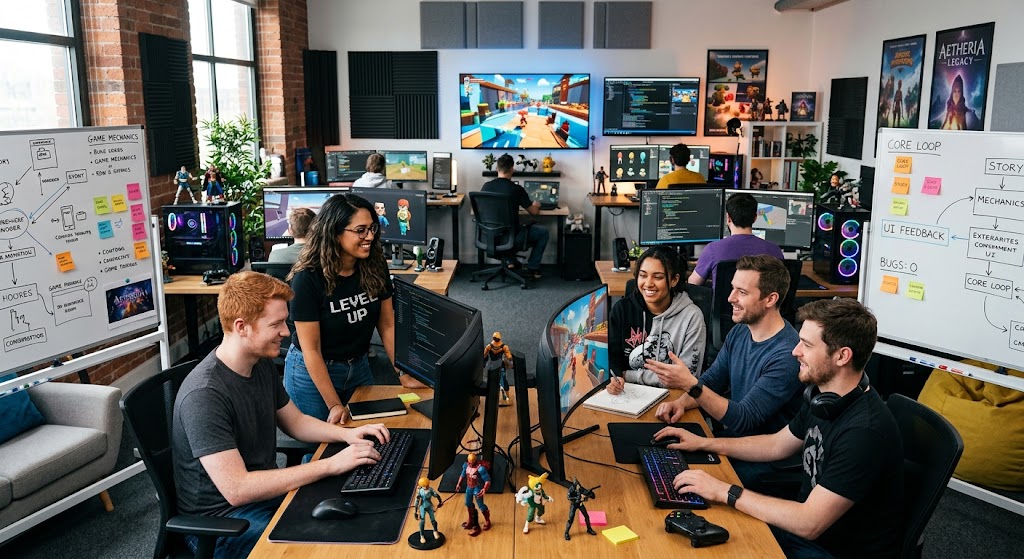
Games Development Studio Essentials for Success
Creating a game today is vastly different from what it was ten years ago. The market moves fast. Player expectations are higher than ever before. If you run or work with a games development studio, you know that passion alone will not keep the lights on. You need structure, vision, and execution.
Every successful games development studio balances artistic freedom with practical business logic. So, how do top teams navigate this delicate balance? Let us look closely at what makes a modern studio thrive in a crowded global market.
It starts with people. You need talented artists, skilled programmers, creative level designers, and sharp project managers pulling in the exact same direction. But even the best talent fails without clear workflow systems and strong operational management.
Building a culture of trust inside a studio is just as important as building good technology. When team members feel supported, creative risks pay off. When communication breaks down, projects stall, budgets explode, and team morale plummets rapidly.
What Every Games Development Studio Needs to Know
Building video games requires a fine mix of technical skill, business discipline, and creative storytelling. A well-oiled games development studio focuses heavily on pre-production. Before writing a single line of production code or sculpting complex 3D assets, teams test concepts rigorously. They build rough prototypes using basic shapes. They throw away ideas that sound cool on paper but feel boring in practice.
This early testing saves incredible amounts of time and financial capital. Here is why it matters. Fixing a design flaw on a whiteboard or during early paper prototyping costs almost nothing. Fixing that same flaw three weeks before launch can ruin a team, delay releases, and burn through reserves.
Let us break down the standard pipeline used by a modern games development studio to maintain efficiency:
- Pre-Production: Concept design, game mechanic prototyping, wireframing, technical architecture planning, team scaling, and budget forecasting.
- Production: Asset creation, level building, core systems programming, audio soundscapes, character animation, and feature integration.
- Post-Production: Quality assurance bug hunting, performance optimization, frame rate stabilization, platform compliance, and multi-language localization.
- Live Operations: Server maintenance, post-launch balancing, community updates, bug fixing patches, seasonal events, and downloadable expansion content.
Managing these stages seamlessly separates amateur groups from professional creators. Every games development studio relies on structured workflows to prevent burnout and keep strict deadlines on track across multi-year schedules.
Budgeting is another vital pillar that requires constant vigilance. Games frequently run over budget when scope grows unchecked. Smart studio directors set hard limits early on. They prioritize core gameplay loops before adding extra features or extra levels that do not add value.
Look at this comparison of common production models used by an independent or mid-tier games development studio today:
| Development Approach | Core Advantages | Main Challenges | Best Fit For |
|---|---|---|---|
| Agile Iterative | Fast adjustments, rapid prototyping, continuous player feedback integration | Potential scope creep, hard to predict exact final production costs | Indie projects, prototype phases, live-service titles |
| Waterfall Sequential | Clear milestone gates, predictable budgets, structured delivery dates | Inflexible to changes late in the development cycle | Contract work, fixed-scope console ports |
| Hybrid Production | Balances creative freedom with strict milestone deadlines and sprint targets | Requires highly experienced project managers to balance flexibility | AA and mid-sized independent studios |
Choosing the right framework sets the tone for the entire team. But workflow structure is only part of the equation when shipping commercial games.
Clear documentation is another key component. When game mechanics, narrative arcs, and technical pipelines are well documented in a shared repository, onboarding new team members becomes effortless. It prevents knowledge silos and keeps the vision clear even as team sizes expand over time.
How a Games Development Studio Builds Engaging Experiences
Player retention depends on how good the core game loop feels in the player’s hands. If moving your character around a screen is not fun, adding fancy graphics will not save your game from negative reviews. A dedicated games development studio spends months tuning small details. Jump heights, response latency, button layouts, visual impacts, camera movement, and audio feedback all count.
Good communication across departments keeps these fine details sharp. Artists need to understand technical engine constraints like polygon counts and memory budgets. Programmers must respect artistic vision and game feel. Designers act as the vital bridge between both creative and technical worlds.
Here is how key internal roles inside a games development studio collaborate during active production phase:
- Game Designers map out rules, difficulty curves, economy models, puzzle structures, and progression systems.
- Engineers build physics models, artificial intelligence behavior, user interface frameworks, graphics shaders, and network architecture.
- 3D Artists create character models, environment textures, animation rigs, visual effects, and dynamic lighting setups.
- Audio Engineers design sound effects, score original music, record voice lines, and mix multi-channel positional audio layers.
- QA Testers systematically test the game to catch game-breaking bugs, collision errors, translation glitches, and performance drops.
When these departments communicate daily through standup meetings and collaborative tools, development speeds up dramatically. Problems get spotted before they turn into major roadblocks that stall release dates.
Technology selection also impacts speed and efficiency. Selecting the right game engine dictates how fast a games development studio can ship a finished project. Proprietary custom engines give full control but demand huge long-term engineering maintenance. Third-party engines like Unity or Unreal Engine offer pre-built tools, physics systems, and rendering pipelines that save years of labor.
Consider the structural breakdown below regarding engine selection for a modern games development studio:
| Engine Platform | Key Strengths | Target Platforms | Typical Team Size |
|---|---|---|---|
| Unreal Engine | Photorealistic visual capabilities, powerful blueprint visual scripting, advanced physics engine | PC, Modern Consoles, High-end Mobile | 10 to 200+ Developers |
| Unity | Cross-platform versatility, vast asset store ecosystem, rapid lightweight prototyping | Mobile, PC, Console, VR/AR Headsets | 1 to 50 Developers |
| Custom Engine | Complete hardware optimization, unique feature tailoring, zero external licensing fees | Specific proprietary hardware platforms | 50+ Senior Engine Engineers |
Making smart engine choices early on keeps projects on schedule. It also allows developers to focus on making great gameplay rather than fighting technical limitations every day.
Marketing must also start early in the timeline. Waiting until launch day to announce your project is a massive commercial risk. A proactive games development studio builds a community from day one. They share behind-the-scenes clips, talk with players on social platforms, post development blogs, and run early playtests.
Building an audience early ensures that you have day-one buyers waiting. It gives your creative team real user feedback long before the official commercial launch.
Here are several practical steps for early audience building used by industry leaders:
- Devlogs: Publish regular video or written updates showing how gameplay mechanics and artwork are created.
- Community Hubs: Set up Discord servers or forums where fans can ask questions and give feedback directly.
- Closed Playtests: Invite active community members to test early builds and gather honest user experience data.
- Storefront Pages: Launch store pages early to collect wishlists and drive organic platform recommendation algorithms.
Combining solid game design with early community engagement builds a firm foundation for any modern games development studio looking to establish its market presence and achieve long-term financial stability.
It is also essential to manage post-launch commitments. A game launch is no longer the end of the journey. For many players, launch day is just the beginning. Continuous support, balancing patches, and responsive communication keep communities active and loyal for years.
Frequently Asked Questions
What Does a Games Development Studio Actually Do?
A games development studio handles the complete development lifecycle of a video game title. This includes conceptualizing the idea, writing code, designing visual assets, scoring audio, testing for bugs, and releasing the final product across digital platforms. Many studios also manage long-term post-launch updates, community support, seasonal events, and ongoing bug fixes to keep games running smoothly for years.
How Much Does It Cost to Hire a Games Development Studio?
Costs vary widely based on scope, team size, art style, technical complexity, and geographic location. Small indie projects might cost anywhere from $20,000 to $100,000. Mid-tier AA projects often range from $500,000 to several million dollars. Major AAA blockbusters routinely exceed tens or hundreds of millions. Rates are typically calculated based on developer hourly rates and total project length.
How Long Does a Games Development Studio Take to Make a Game?
Production timelines depend directly on project scope and visual fidelity. A simple mobile puzzle game can take three to six months. A detailed 2D indie title usually takes one to two years. Full-scale 3D console and PC games created by a mid-sized games development studio often take three to five years of continuous work from pre-production through final market release.
What Roles Exist Inside a Games Development Studio?
Core internal roles include game designers, software engineers, 3D and 2D artists, animators, sound designers, writers, quality assurance testers, and project managers. Larger organizations also employ specialized staff like narrative directors, backend server engineers, monetization designers, user experience specialists, and dedicated community management teams.
How Do I Choose the Right Games Development Studio for My Project?
Look closely at their portfolio, published titles, client testimonials, and technical capabilities. Ensure they have proven experience in your target genre and engine platform. Clear communication habits, transparent milestone tracking, fair intellectual property terms, and realistic time estimates are strong indicators of a reliable development partner.
Can a Games Development Studio Help with Game Publishing?
Some development studios offer co-publishing services or maintain strong relationships with major global game publishers. While their main expertise is building the product, experienced teams frequently assist clients with store submission processes, console certification, localization, marketing asset creation, and compliance requirements across platforms.
Why Should I Work with a Games Development Studio Instead of Freelancers?
Working with an established studio provides a cohesive, pre-organized team with unified workflows, established tools, and proven project leadership. Managing individual freelancers requires massive operational oversight, coordination effort, and quality management. A professional games development studio takes complete accountability for project delivery, quality standards, and overall technical performance.
Building a successful game requires vision, discipline, technical prowess, and execution. Partnering with or running a dedicated games development studio ensures that creative ideas are translated into polished, market-ready experiences that captivate players globally.
