
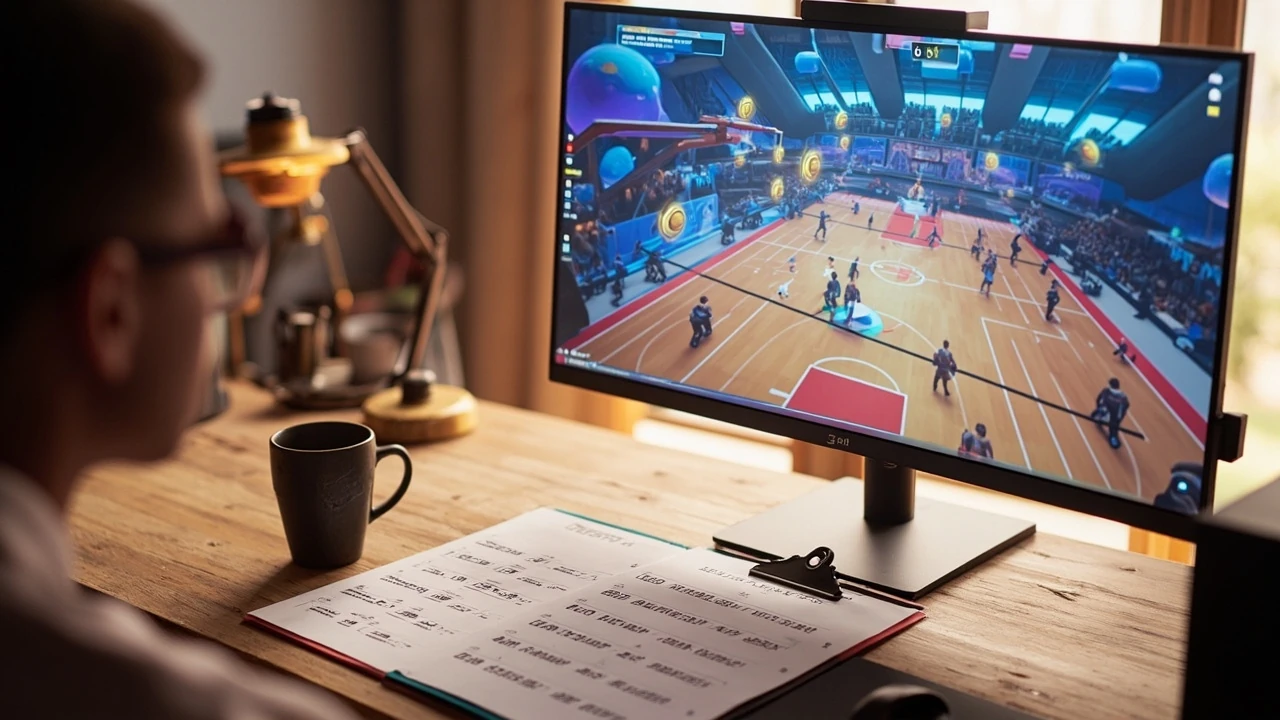
Playground basketball codes and what they actually do under the hood
A player searching for playground basketball codes is usually trying to skip the grind, but a developer reading the same phrase is trying to understand the mechanism that makes those codes worth redeeming. Playground Basketball is a Roblox experience built around short, repeatable basketball matches, and its code system hands out coins that buy cosmetic items such as shoes, jerseys, and effects. From the player’s chair the code is a free shortcut. From the developer’s chair it is a small live ops surface with real design, retention, and moderation consequences.
As of late August 2026 the developer has not pushed a fresh update, and that also means no new codes. The most useful thing a working game developer can do in that quiet window is study the code system itself: the player requirements, the redemption flow, the rewards table, the cadence, and the failure modes. That is what this article focuses on. It is a developer-side reading of a player-facing feature, written for people who ship, port, or maintain similar Roblox titles and want to understand the moving parts before copying them.
The practical reference for the current code list and the step-by-step redemption flow comes from PC Gamer’s Playground Basketball codes guide, which documents the like-and-join prerequisite, the in-launcher redemption path, and the cosmetic coin payouts that codes are known to deliver.
What the player sees, and what the developer must implement
The player journey for playground basketball codes is short and predictable. A new player opens the experience, plays a match or two, then hears about a code from a creator, a Discord, or an article. They leave the experience, open the Roblox launcher, like the game and join the Community Group, reload the experience, and paste the code into a redemption field. Within seconds their coin balance jumps and a cosmetic store they could not previously afford becomes reachable.
For a developer, every step in that journey is a decision. The like-and-join gate is not a bug. It is a deliberate acquisition and retention lever that the platform makes easy to wire up. The launcher’s role is to confirm that the redeeming account meets the social requirements before the server ever sees the request. The reload step is what guarantees that the platform’s verification is fresh, because Roblox only re-evaluates group membership and game likes when a session is established. The in-experience code field is just a presentation layer on top of a backend that has to be rate-limited, versioned, and tested.
The two account actions the Roblox launcher gates
- Liking the experience through the Roblox launcher, which signals soft endorsement and feeds the platform’s discovery graph.
- Joining the official Community Group associated with the experience, which turns the code redemption into a soft subscription rather than a public free-for-all.
Both actions are surfaced in the launcher, which means a developer can write UX copy that says “do this once in the launcher” and trust that the platform will not change the location of those buttons in a meaningful way over a short support window. That reliability is part of why the gate is so widely used in Roblox live ops design.
Designing the coin economy that the codes feed into
Codes are only valuable if the coin economy they reward is interesting. A naive system simply hands out coins and lets the player buy the most expensive item. A well-designed system pays out coins in a curve that matches how a player progresses and how a new season should feel. Playground Basketball uses codes as a top-up rather than as a primary income, so most of a player’s coin balance still comes from matches, dailies, and limited events. Codes exist to accelerate cosmetic acquisition for engaged players and to give content creators a hook to drive traffic during a quiet patch.
For a developer, the core design questions are simple but consequential. How many coins should a single code grant relative to a single match reward. How many codes should be active at once. How long should a code live before it expires, and should it be single-use per account, single-use globally, or unlimited. What happens to the cosmetic catalog between code waves. None of these questions have a universal answer, but they do have a small set of robust patterns that can be adapted.
| Decision | Common pattern | Effect on the player | Effect on live ops |
|---|---|---|---|
| Reward size per code | 2,000 to 5,000 coins for a typical title | Feels meaningful without trivialising the store | Adjustable without rebalancing the whole economy |
| Active code count | Three to five at any time | Gives creators something to share without saturation | Easy to audit and rotate |
| Code lifetime | Seven to thirty days, or until the next drop | Creates real urgency without scaring new players | Limits stale-code support load |
| Use model | One redemption per account, server-validated | Stops share-and-redeem loops in friend groups | Simplifies analytics and abuse detection |
| Failure feedback | Clear reason: expired, used, not eligible, unknown | Reduces support tickets and chat spam | Makes telemetry readable |
Each row is a lever the developer can pull independently. The interesting design work is in choosing the combination. A title that wants a strong creator economy usually keeps reward sizes modest and code counts high, because creators want frequent reasons to mention the game. A title that wants a calmer cadence keeps counts low and reward sizes generous, treating codes as a thank-you rather than a news feed.
How a Roblox code redemption is actually wired
Behind the UI, a Roblox code redemption is a request from the client to a backend service that checks three things: the account is allowed to redeem, the code is currently valid, and the reward has not already been granted. The like-and-join check is enforced upstream by the launcher. The code validity check is enforced by a small data table that maps string identifiers to reward bundles and lifetime windows. The grant check is enforced by a persistent record that the server can query.
A reasonable internal implementation, written here as pseudocode rather than a tested production API, looks roughly like this for a Roblox-style title:
- The client sends a
RedeemCodeRequestwith the player’s user identifier and the typed string. - The server looks up the code in a campaign table, returning the reward bundle and an expiration timestamp.
- The server confirms that the current server time is before expiration and that the code is currently active.
- The server checks a
CodeRedemptionstable for an existing row keyed by the user identifier and the code identifier. - If no row exists, the server inserts one, increments the player’s currency by the reward amount, and returns success.
- If a row exists, the server returns a clear “already redeemed” error without changing any state.
The two records that matter most are the campaign table and the redemption ledger. The campaign table is a small, frequently-edited document. The redemption ledger is a write-heavy log that should be indexed by the user identifier and pruned or aggregated over time. Most bugs in real code systems fall into one of three buckets: the campaign table is edited without redeploying the live service, the redemption ledger is not unique-indexed so a retry double-grants, or the expiration check uses client time instead of server time.
| Failure mode | Symptom | Likely cause | First check |
|---|---|---|---|
| Codes do nothing on paste | Player reports a code “doesn’t work” with no error | Campaign table not loaded by the live shard | Confirm hot-reload and shard version |
| Coins granted twice | Player balance jumps after a retry | Redemption ledger missing unique constraint | Inspect duplicate rows per user |
| Expired codes still active | Old code keeps granting after the listed date | Server clock skew or local-time check | Compare server UTC with stored timestamp |
| Like-and-join error | Player insists they liked and joined | Session started before action completed | Tell player to fully restart the experience |
| Code accepted on web, rejected in-game | Different error messages | Two redemption paths reading different tables | Unify backend, remove legacy web field |
These are the kinds of failure modes that a player only sees as “the code does not work.” A developer who has thought through them ahead of time can ship a small code system in a day and keep it running for years without drama.
The social gate: why the like and join exist
Most Roblox code systems include a soft social requirement, and Playground Basketball’s like-and-join gate is a textbook example. The technical function is verification. The design function is acquisition. The platform function is a feedback loop into Roblox’s discovery systems, which reward experiences with high like counts and active community groups with more visibility in search and recommendations.
For a developer, this matters because the code redemption surface is one of the few places in the experience where a player is explicitly told to perform a platform-level action. That makes the copy around the code field unusually high-leverage. A clear sentence that says “like the game and join the Community Group in the Roblox launcher, then restart the experience” is doing more than helping the player. It is training the player to think of the launcher, the group, and the experience as one connected system. That habit pays off every time the developer wants to push a community-only event, a playtest, or a creator collab.
The downside is that the social gate is also where accessibility and regional friction live. A player on a managed device, in a region with limited launcher access, or in a household with strict Roblox parental controls may not be able to complete both actions even if they want to. A developer thinking carefully about the system will write a help article that names the launcher buttons, names the Community Group, and offers an alternative way to verify if the gate ever changes. That kind of help content is also a strong signal to platform moderators that the title takes its community seriously.
Cadence: when to drop codes, and when to stay quiet
There is a real rhythm to code drops in a healthy Roblox title. Codes usually appear with content updates, with seasonal events, and with creator partnerships. They rarely appear during a quiet week, because a code is essentially a free marketing event: every code drop is a chance for creators to publish a list, for the studio to send a notification, and for search engines to refresh an article. If a developer pushes a code every week with no underlying content change, the next “real” code drop lands on a fatigued audience.
The current Playground Basketball situation, with no new codes during a quiet patch, is actually a healthy signal. The existing code set still works, players still have something to redeem, and the next drop will arrive with an actual reason. A developer designing their own schedule can copy that pattern in three rules of thumb:
- Pair each code drop with a visible content change, even a small one, so creators have a reason beyond the coins.
- Keep at least one or two codes active during quiet weeks so the redemption field never feels dead.
- Reserve a small “event-only” code pool for community nights, creator tournaments, or studio milestones.
Cadence is also where the studio’s content team and live ops team have to agree. A code drop that ships without a content beat is a free coin handout. A code drop that ships with a content beat is a small launch.
What “coins” actually buy, and why it matters
Codes in Playground Basketball pay out in coins, and the catalog those coins buy is mostly cosmetic: shoes, jerseys, effects, and similar surface-level customisation. That is not an accident. Cosmetic-only sinks are the safest way to use a free currency grant, because the player who redeems a code does not gain power over other players and does not change the competitive economy. They just look slightly different on the court.
For a developer, the implication is that the code system is effectively decoupled from matchmaking integrity. A player who redeems ten codes does not suddenly have a better chance of winning a match. They just have a fuller wardrobe. That decoupling is what makes a coin-based code system tolerable in a competitive Roblox title. A system that granted power items would have to ship with a much heavier moderation and balance review, and it would be a much louder signal to platform holders about what kind of economy the studio is running.
Studios porting a code system from one game to another often miss this distinction. They see “coins” and assume any sink will do. In practice, the right catalog for a code-funded economy is a catalog that is fun to fill out, cheap to ship new items into, and visually obvious in the lobby. Cosmetics tick all three boxes. Functional items, currency exchanges, and progression skips usually do not.
Localising and moderating a code drop
Once a developer has a working code system, the next questions are usually about reach and safety. Roblox has a young audience and a global audience at the same time, so a code system has to behave well in both contexts. The launcher’s like-and-join gate handles part of the social safety story. The rest is up to the studio.
Three practical rules tend to hold up across small studios and large ones:
- Treat the code field as a public surface. Anything shown in the field or in the success message can be screenshotted and shared, so keep copy neutral and do not promise more than the system can deliver.
- Localise the field label and the success message, not just the surrounding UI. A player whose launcher is set to Portuguese should see the same code field in Portuguese, with the same failure reasons translated.
- Log redemption events with enough context to detect abuse, but not so much that you are storing personal data you do not need. User identifier, code identifier, timestamp, and a coarse region tag is usually enough.
These are unglamorous decisions, but they are the difference between a code system that survives a year and one that gets pulled after a moderation complaint.
Comparing playground basketball codes to similar Roblox code systems
Almost every successful Roblox sports or sports-adjacent experience runs a code system that looks broadly like Playground Basketball’s: a small set of active codes, a social gate, a coin reward, and a cosmetic catalog. The differences are in the tuning, not the architecture. Looking at the patterns side by side is useful for a developer who is choosing a baseline for a new title.
| Element | Playground Basketball pattern | Common alternative | When to pick the alternative |
|---|---|---|---|
| Social gate | Like the game and join the Community Group | Group-only, no like requirement | When the studio wants a stricter, smaller community |
| Reward type | Cosmetic coins | Boost tokens, XP, or time-limited items | When the title has a stronger progression loop |
| Redemption surface | In-experience field | Web page or Discord bot | When the studio wants cross-promotion outside the client |
| Code lifetime | Until the next drop, often weeks | Strict 48 to 72 hour window | When the studio runs live events and wants urgency |
| Use model | One redemption per account | Unlimited until expiration | When the reward is meant to be a daily nudge |
None of these alternatives is strictly better. They are different bets about what the code system is for. Playground Basketball’s pattern treats codes as a soft acquisition tool and a creator hook. A stricter pattern treats codes as an event-driven reward. A developer should pick the pattern that matches the studio’s content rhythm, not the one that happens to be loudest in the current Roblox charts.
Telemetry and analytics for a code system
A code system that is not measured is a code system that cannot be improved. The minimum telemetry a developer should collect is straightforward, and it pays for itself quickly. For each redemption attempt, log the user identifier, the code identifier, the result code, the timestamp, and the platform region. For each code campaign, log the start time, the end time, the reward bundle, the total attempts, the unique redeemers, and the conversion rate from launcher to in-experience redemption.
Those two datasets answer most of the questions a live ops lead will ask. Which code produced the most redemptions. Which code produced the most redemptions per dollar of reward. How many players completed the social gate within an hour of starting the experience. How many players redeemed and then stopped playing, which is a soft churn signal. None of this requires a custom analytics stack. A simple event log and a daily aggregate query is enough to inform the next drop.
A common mistake is to treat code redemptions as the headline metric. They are not. The headline metric is what the player does after the redemption. A code that drives a long session is doing real work. A code that drives a five-second wardrobe visit is mostly doing marketing.
Failure modes a developer should design for in advance
Even a small code system accumulates failure modes as it ages. The first six months are easy: the campaign table is short, the codes are simple, and the redemption path is one route. After that, the studio starts to add events, regional variants, partner drops, and creator collabs, and the system grows corners. The failure modes that show up most often in that grown-up state are predictable.
- Stale codes that no developer remembers to retire, leaving the field cluttered with non-functional entries.
- Two campaigns that share a code string, usually because a partner drop used a string that already existed in a retired campaign.
- Region-specific rewards that the studio forgot to translate, so a player in one region sees a string and a reward that do not match.
- A live ops on-call rotation that does not have access to the campaign table, so a real outage turns into a multi-day investigation.
- A moderation flag on a code that included a word a younger audience is not allowed to see, even though the word was meant as a friendly label.
Each of these is solvable in advance with a short runbook, a single source of truth for active codes, and a one-page guide for whoever is on call. None of them is glamorous. All of them are cheaper to design for than to debug live.
Building a code system on top of an existing Roblox title
For a developer already running a Roblox experience, the fastest way to add a playground-style code system is to copy the surface, not the backend. The surface is the in-experience field, the help article, and the social gate. The backend can be as simple as a DataStore with a campaign table and a redemption ledger, both of which fit comfortably inside Roblox’s standard storage quotas for a small title.
The implementation order that tends to work best is roughly:
- Define the data model: a campaign record, a redemption record, and a reward bundle record.
- Wire the server endpoints for redeem, status, and admin list, with clear error codes for each failure case.
- Build the in-experience UI, keeping the field prominent and the help text short.
- Add the like-and-join gate, with a clear copy explaining where the buttons live in the launcher.
- Add the analytics events and a small dashboard, even if the dashboard is a daily CSV.
- Write the public code list and the help article, and keep them on a short update cadence so creators can rely on them.
That order puts the data model first, because every other layer depends on it. It puts the analytics near the end, because the analytics is only useful once the data model is stable. And it puts the public code list and the help article at the end, because the studio should not promise players a code system that is not yet wired up to the same backend as the game.
Where the help article lives, and what it should cover
Most players who search for playground basketball codes never read a developer’s help article, but the few who do tend to be the players who hit the edge cases. A well-written help article protects those players and protects the studio’s support load at the same time. A useful article covers the prerequisites, the redemption path, the current code list, the typical reward, and the common error messages with one sentence each.
What the help article should not do is speculate about future codes, leak unreleased rewards, or promise that a quiet patch will end on a particular date. The article is part of the studio’s public surface, and it should read like a careful product page rather than a hype post. The current state of Playground Basketball, with no fresh update and no new codes, is exactly the kind of situation where a disciplined help article is more useful than a stream of social posts: a player can read it once, see that nothing has changed, and come back when the next drop lands.
What a developer can learn from a quiet patch
The interesting thing about the current Playground Basketball situation is what it teaches about a healthy live ops rhythm. A quiet patch with no new codes is not a failure. It is the studio saving the next code drop for a moment that actually warrants one. A developer who studies that rhythm can apply it to their own title: do not spend the marketing budget on codes when there is no content to support them, and do not let the code list sit empty during a content beat.
That is also why existing code sets are worth redeeming during a quiet patch. A player who redeems an existing code, likes the game, and joins the Community Group is doing exactly the three actions the studio wants from a healthy player. The studio is happy, the player is happy, and the next code drop arrives with an audience that is already warmed up. From a developer perspective, that is the loop a code system is supposed to support, and Playground Basketball runs it cleanly.
Frequently asked questions
What do playground basketball codes actually give a player?
The current code set grants in-game coins, which are used to buy cosmetic items such as shoes, jerseys, and effects from the in-experience store. The codes do not grant power items, progression skips, or anything that affects matchmaking. The reference for the current list and the cosmetic catalog is the PC Gamer code guide, which documents the coin payouts and the social prerequisites for redeeming them.
Why does the player have to like the game and join a group before redeeming?
The like-and-join gate is enforced by the Roblox launcher, not by the in-experience code field. It functions as a soft acquisition and retention tool: the launcher confirms that the redeeming account has both liked the experience and joined the Community Group before the server will accept the redemption. The gate is also why the launcher, not the in-experience UI, is the right place to tell a player what to do.
How long is a typical playground basketball code active?
Codes in Playground Basketball tend to stay active until the next drop, which is often a few weeks. The exact lifetime of any individual code is set by the studio and can change between campaigns. A player who wants to be sure of a code’s status should check the most recent public code list rather than relying on memory.
Can a code be redeemed more than once on the same account?
Most Roblox code systems, including Playground Basketball’s, treat each code as a one-redemption-per-account item. The server stores a record that the player has redeemed the code and rejects any later attempt on the same account. That record is what stops share-and-redeem loops in friend groups and what keeps the coin payouts predictable for the studio.
Why are there no new codes right now?
There are no new playground basketball codes at the moment because the developer has not pushed a fresh update. A quiet patch with no new codes is normal in a healthy live ops rhythm, because a code drop is usually paired with a content beat. Existing codes still work during the quiet window, and the next drop will arrive with the next update.
What is the safest way to add a similar code system to another Roblox title?
Start with a small data model: a campaign table, a redemption ledger, and a reward bundle table. Build the server endpoints with clear error codes, add the social gate through the Roblox launcher, and only then build the in-experience UI and the public help article. That order keeps the studio from promising a feature the backend cannot yet support, and it produces a code system that is small enough to maintain.
How should a studio measure whether a code drop worked?
The minimum telemetry is the redemption count per code, the unique accounts that redeemed, the conversion from launcher action to in-experience redemption, and the player’s session length after the redemption. Those numbers answer the two questions a live ops lead actually asks: did the code reach the intended audience, and did those players stay engaged after the reward landed. A daily aggregate is usually enough; a full real-time dashboard is rarely worth the cost for a small title.
What is the most common bug in a Roblox code system?
The most common bug is a redemption ledger without a unique constraint, which lets a retry grant coins twice. The second most common is a campaign table that is edited without a redeploy, which leaves the live service reading the old code list. Both bugs are cheap to prevent with a strict data layer and a clear deploy checklist, and both are expensive to debug after the fact because the symptoms look like a player error.
