
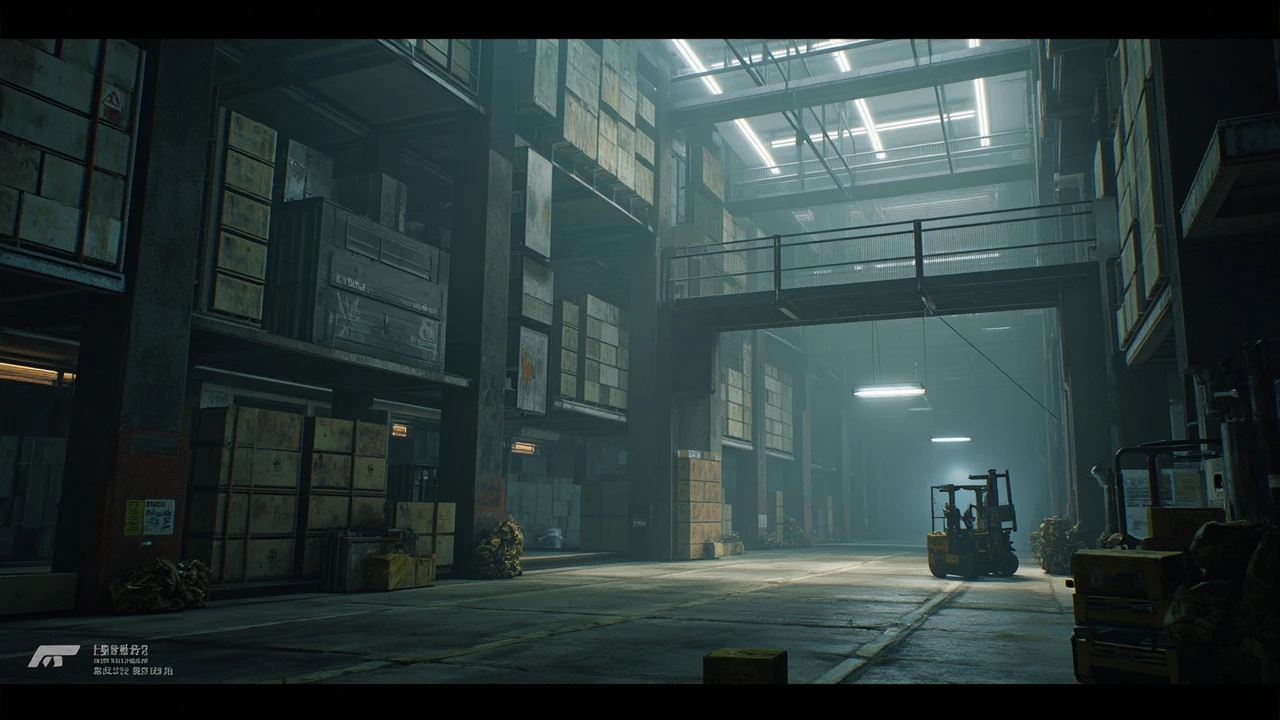
Jiangsu warehouse in ARC Raiders: what the location is and why it matters to the extraction loop
ARC Raiders is a third-person extraction shooter built around contested surface zones, a single shared map surface, and loot economies that punish and reward greed in equal measure. The Jiangsu warehouse is one of the named interior points of interest that designers use to break up the open topography of the main map, concentrating combat, scavenging, and route decisions into a tight, multi-storey industrial volume. For players it shows up as a high-density loot node with strong vertical play, defined sightlines, and a small set of chokepoints. For developers and level designers it is a useful case study because it illustrates how an interior POI in a PvPvE extraction game can sustain tension without becoming a single load-bearing death corridor.
This article treats the Jiangsu warehouse as a level-design specimen inside ARC Raiders. It walks through what the location is, how it is laid out and lit, which mission hooks tend to send players there, what the encounter design and economy look like, and how the space interacts with the broader extraction loop. The goal is a single, evidence-based reference that helps players plan runs and gives developers a vocabulary for talking about interior POI design in the same genre.
ARC Raiders in context: setting up the design language the warehouse sits inside
ARC Raiders is a free-to-play, third-person, cooperative and competitive extraction shooter developed by Embark Studios and published by Embark itself. The game is set on a post-collapse Earth where surface-dwelling humans, known as Raiders, scavenge above ground while mechanized ARC units patrol the ruins. Players spawn into a shared world, gather resources, complete objectives, and decide when to extract before losing everything in a firefight. The [ARC Raiders Wikipedia entry](https://en.wikipedia.org/wiki/ARC_Raiders) describes the title’s core loop, the Embark Studios development lineage, and the way the studio has framed the game as a long-running live service rather than a one-off release.
Two design choices are worth flagging up front because they shape how any interior point of interest, including the Jiangsu warehouse, has to behave. First, the world is treated as a single connected surface. Players traverse it on foot and in light vehicles, and interiors are not separate loading zones but real volumes inside the persistent map. Second, encounters are mixed: ARC machines, environmental hazards, and other player squads all share the same space. An interior POI therefore has to balance loot density, mobility options, and the constant possibility of human opposition, all while letting the AI patrols read the geometry correctly.
Because of that background, the Jiangsu warehouse is not a generic raid dungeon. It is a designed piece of the open world that players route through, fight over, and occasionally use as a base of operations for short sessions. The rest of this article looks at how that role is constructed.
What kind of place the Jiangsu warehouse is in the world
The Jiangsu warehouse is a large industrial complex built around a central storage hall, with attached loading bays, a raised catwalk system, and a service annex that most players reach through a side stairwell. Externally, the building is marked by a faded metal sign and the kind of hazard stencils that imply a logistics hub operating before the collapse. Internally, it reads as a working storage facility: tall pallet racking, stacked polymer crates, idle robotic forklifts, and a concrete loading floor sized for freight vehicles.
For design purposes, the location sits in a middle band between two extremes that often appear in extraction shooters. On one end are tight, claustrophobic interiors with very short sightlines and brutal close-quarters combat. On the other are open warehouses used mainly as cover against long-range fights in the surrounding terrain. The Jiangsu warehouse leans toward the second end but adds enough internal structure that long sightlines are broken by racking and crates, and vertical play becomes a real option through the catwalks and the roof access points.
That position in the spectrum explains why the location appears in mission design. It is large enough to host multi-squad encounters without collapsing into a single firefight, and it is structured enough to give players meaningful choices about which floor to hold and which route to take out.
Reading the floor plan: halls, catwalks, and the loading bay
The most useful way to discuss the Jiangsu warehouse is to treat it as a three-zone interior: the main storage hall, the loading bay, and the service annex. Each zone has a distinct role in combat and a different relationship to the surrounding terrain.
| Zone | Primary role | Cover density | Vertical play | Loot profile |
|---|---|---|---|---|
| Main storage hall | Mid-range fights, routing | High, organised in racking rows | Catwalk level, roof access | Mid-tier components, parts |
| Loading bay | Vehicle approach, long sightlines | Medium, scattered crates and vehicles | Limited; balcony and crane access | Bulk resources, vehicle parts |
| Service annex | Flank routes, close quarters | Low, tight corridors | Stairwell, mezzanine | Quest items, rare drops |
The main storage hall is where most players spend their time. It is organised in long rows of pallet racking that create repeating cover lanes, with the catwalk running along the upper level and several roll-up doors on the ground floor. The hall is the kind of space that supports both methodical looting and abrupt close-quarters fights, because the racking breaks sightlines at roughly 15 to 20 metres while the catwalk opens up longer angles when someone takes a high position.
The loading bay is a transitional zone. Vehicles can reach the roll-up doors from outside, which makes it a common entry and exit point for squads moving between the warehouse and the wider terrain. Loot in the bay is heavier and more exposed, so it tends to draw firefights when several squads converge on the same extraction path.
The service annex is the smallest and most contained of the three. A side stairwell leads up to a mezzanine with utility rooms and what appears to be a partially destroyed office area. It is where the rarer quest items tend to spawn, and it is also the most dangerous place to be caught, because the corridors are tight and there are few ways to disengage cleanly.
Lighting, sound, and how the warehouse sets the tone
Lighting in the Jiangsu warehouse is built around a contrast between two systems: cold overhead fluorescent tubes, some of which are functional and some broken, and warm sodium floodlights positioned near the loading bay. The combination does more than decorate. Cold light is associated with the interior storage space and tends to flatten colours and reduce contrast at medium range, which favours players using darker loadouts. Warm light pools at entrances and exits, drawing attention to routes in and out of the building.
Sound design follows the same logic. The hall has a low ambient hum from the surviving electrical systems, broken up by the occasional creak of racking under wind load and distant ARC machine footsteps on the surface above. Footsteps on the metal catwalks carry further than on the concrete floor, which means that taking the high ground has both an information cost and an information benefit. A squad on the catwalk can see more of the hall, but their movement is audible from farther away.
For developers, the lighting and sound design choices are worth studying because they illustrate a useful principle. In an extraction shooter, interiors need to communicate risk through environmental cues before any HUD element is read. The Jiangsu warehouse does this by making the safe-looking low ground feel visually exposed and the tactically attractive high ground feel audibly exposed.
Why the Jiangsu warehouse appears so often in mission design
Several recurring mission types in ARC Raiders route players into or through the Jiangsu warehouse. The pattern is consistent enough that it is worth treating the location as a quest hub rather than a single encounter.
- Salvage contracts: high-volume loot retrieval that takes advantage of the bulk resources in the loading bay and the component density of the storage hall.
- ARC unit disruption: missions that require players to destroy or disable patrol nodes located on the catwalks and roof, which then draws AI attention into the interior.
- Data retrieval: tasks that target the service annex and its utility rooms, often tied to a specific named NPC or faction questline.
- Extraction interference: defensive or offensive objectives that use the warehouse as a contested extraction point, with multiple squads converging on the loading bay.
From a design standpoint, the reason the warehouse works for all four categories is the same. It contains enough different micro-environments that mission scripts can route players into the hall, the bay, or the annex without feeling like the same fight every time. A salvage run might never leave the storage hall. A data retrieval run will almost certainly pull players into the annex. A defensive extraction will spill out into the loading bay and the surrounding terrain. The single location supports multiple mission flavours without redesigning the space.
Encounter design: how fights actually unfold in the warehouse
Encounters in the Jiangsu warehouse follow a few repeatable patterns, and recognising them is useful both for players planning a route and for developers thinking about interior POI design in general.
- The catwalk standoff: one squad holds the upper level while another tries to push through the racking below. The geometry favours the defenders, but the catwalk is noisy and exposed to fire from the loading bay.
- The annex pinch: a squad moves into the service annex for a quest item, then finds itself pressed by another squad coming up the stairwell. The annex is small enough that a single well-placed utility item can lock the route.
- The bay rush: a vehicle-borne squad attempts to extract directly through the loading bay, drawing fire from the catwalk and from squads holding the hall. The bay is the most exposed space in the location, and the fight tends to resolve quickly.
- The silent loot: a squad enters the hall when no other players are present, loots in relative quiet, and exits through a side door before ARC patrols converge. This is the most efficient way to use the location and the rarest in busy sessions.
Each pattern has a different risk profile, and the building is designed so that no single one of them is always dominant. A squad that always tries the catwalk standoff will eventually run into a bay rush, and a squad that always tries the silent loot will eventually be caught by an annex pinch. Variety in encounter patterns is part of what makes the location feel alive over repeated runs.
Loot economy and risk: what the warehouse is actually worth
The Jiangsu warehouse sits in the middle of the map’s loot hierarchy. It is not the highest-value interior on the surface, but it offers a better density of usable components than most open terrain. Players running through the warehouse can expect mid-tier crafting parts, a reasonable chance of vehicle components near the loading bay, and a low but non-zero chance of quest items in the service annex.
| Risk profile | Typical loot value | Squad traffic | Recommended squad size | Time in location |
|---|---|---|---|---|
| Low (off-peak) | Mid-tier components, common parts | Light | Solo or duo | 5 to 8 minutes |
| Medium (mixed traffic) | Mid-tier plus occasional rare drop | Moderate | Duo or trio | 8 to 12 minutes |
| High (hot session) | High variance, contested extraction | Heavy | Full squad, well-equipped | 12 to 20 minutes |
One reason the warehouse stays in regular rotation is that even low-risk runs tend to pay for the ammunition and utility items they consume. A solo player who enters during an off-peak window, clears the annex quietly, and extracts through a side door can usually come out ahead on materials. The location scales up gracefully when traffic is heavier, because the extra squads are also competing for the same loot, and a well-played team can convert a contested bay into a high-value extraction.
How the Jiangsu warehouse connects to the wider extraction loop
The For additional context, extraction loop in ARC Raiders is built around three decisions: where to go, what to take, and when to leave. The Jiangsu warehouse shapes each of those decisions.
- Where to go: the warehouse is a natural waypoint between several of the map’s named regions, and the loading bay is a common transit point for squads moving between interior and exterior objectives.
- What to take: the racking and crates present a real choice between carrying a small amount of high-value loot and a larger amount of bulk resources. The former is faster to extract, the latter is more valuable but requires either a vehicle or a clean run to the bay.
- When to leave: the catwalks and the service annex both create pressure to extract earlier than planned. A squad that stays too long in the annex risks being pinched, and a squad that stays too long in the hall risks being flanked from the bay.
For the live service as a whole, this kind of decision pressure is what makes a single interior point of interest sustain engagement across many sessions. Players learn the location’s rhythm, and they keep coming back because the decisions it forces are not the same in every run.
Developer takeaways: what the warehouse illustrates about interior POI design
For developers and level designers, the Jiangsu warehouse is a useful example of how to design an interior point of interest inside an extraction shooter. Several of its choices are worth highlighting because they generalise to similar projects.
- Multi-zone layouts create variety without changing the building. The hall, bay, and annex read as one location, but they support different fights and different mission types.
- Vertical play is integrated, not bolted on. The catwalks are part of the natural flow of the space, which means players use them without needing a tutorial prompt.
- Lighting and sound carry as much information as geometry. The contrast between cold interior light and warm bay light, and the difference between metal and concrete footsteps, are real gameplay signals.
- Risk scales with traffic, not with the location. The same building is safe during off-peak sessions and dangerous during hot ones, which keeps the design honest without per-session rebalancing.
For studios working on similar projects, the practical lesson is that an interior point of interest does not need to be a raid-sized space to feel important. It needs to be structured enough to support a few repeatable encounter patterns, lit and sounded in a way that communicates risk, and connected to the wider map in a way that makes it a meaningful waypoint rather than a dead end.
Player checklist: how to run the Jiangsu warehouse efficiently
For players, the Jiangsu warehouse rewards a small set of habits. The list below is a starting point and not a universal rule, because traffic and squad composition change every run.
- Decide on entry and exit doors before entering. The roll-up doors in the loading bay and the side door near the annex are the most common options, and committing to one in advance reduces hesitation mid-fight.
- Listen before moving onto the catwalks. Metal footsteps carry, and the upper level is only worth holding if you know the rest of the hall is clear.
- Treat the annex as a high-risk, high-reward zone. Plan the route in, grab the target, and leave on the same path. Lingering in the annex is the most common cause of lost runs.
- Watch the loading bay for vehicles. A vehicle entering the bay is a strong signal that another squad is extracting, which means the bay is about to become the most contested space in the location.
- Carry less than you think you need. The warehouse rewards quick extraction, and a lighter pack is easier to move through the racking and out the side door.
None of these are strict rules. They are the kinds of habits that experienced players tend to develop after several dozen runs, and they are useful precisely because the location’s design supports them.
Common failure modes and how to avoid them
Most failed runs in the Jiangsu warehouse fall into a small set of patterns. Recognising them in advance is the easiest way to improve.
- Overstaying in the hall. The hall feels safe because of the cover, but the longer a squad stays, the more likely another squad is moving in from the bay or the annex.
- Fighting on the catwalk without a plan. The catwalk is a strong position, but it is also a loud one. A squad that takes the high ground without a clear plan for what to do next tends to lose the position quickly.
- Splitting the squad across zones. The hall, bay, and annex are close enough to support each other, but far enough apart that a squad split across them is usually a squad that loses half its members to a pinch.
- Extracting from the bay under fire. The loading bay is the most visible extraction point, and a contested extraction there is a long, exposed fight. Choosing the side door instead is usually safer.
These failure modes are also useful from a design perspective, because they are exactly the situations the location is designed to create. The warehouse is built to punish overstaying, to reward planned high ground, and to force squads to make hard choices about extraction routes.
How the warehouse compares to other named interior POIs in ARC Raiders
The Jiangsu warehouse is not the only interior point of interest in the game, and a quick comparison helps put its role in context.
| Location | Size | Primary loot focus | Common encounter pattern | Best squad size |
|---|---|---|---|---|
| Jiangsu warehouse | Large interior, three zones | Mid-tier components, vehicle parts | Mixed catwalk and bay fights | Duo or trio |
| Smaller industrial sites | Compact, single zone | Common parts, low-tier resources | Quick close-quarters fights | Solo or duo |
| Ruined civic buildings | Medium, vertical heavy | Quest items, rare drops | Stairwell and rooftop fights | Trio |
| Open terrain POIs | No interior | Variable, often high-tier | Long-range engagements | Full squad |
The comparison shows the warehouse’s specific role. It is the interior that best supports a duo or trio that wants consistent loot without committing to a full squad. Smaller sites are easier but pay less, civic buildings pay more but are riskier, and open terrain is a different game entirely. For developers, the comparison also shows how a set of named interiors can be balanced against each other to cover different squad sizes and playstyles without overlapping too heavily.
What the Jiangsu warehouse tells us about ARC Raiders as a live service
Locations like the Jiangsu warehouse are a useful indicator of how Embark Studios is thinking about ARC Raiders as an ongoing product. The game is structured around a single, evolving map surface, and interior points of interest are the parts of that surface that get reused the most. A well-designed interior POI shows up in salvage contracts, faction missions, event windows, and extraction interference tasks. A poorly designed one becomes a route players avoid.
For a studio shipping an extraction shooter as a live service, that reuse is the whole point. The map surface is the long-term investment, and individual locations are the assets that pay back that investment over many patches. The Jiangsu warehouse is a small example of that pattern, and the fact that it remains a regular waypoint in mission design is, in itself, a positive signal about how the studio is treating the long-term layout of the game.
For players, the practical implication is that interiors like the warehouse will continue to evolve. Lighting, loot tables, mission hooks, and the behaviour of ARC patrols can all be adjusted without redesigning the building. For developers, the implication is that designing a location for reuse is more important than designing it for a single encounter.
Frequently asked questions
Where is the Jiangsu warehouse in ARC Raiders?
It is one of the named interior points of interest on the main map surface, positioned between several exterior zones so that squads route through it when moving between missions or extraction points. The exact coordinates shift with map updates, but the warehouse remains a stable landmark thanks to its large footprint, the loading bay facing outward, and the faded Jiangsu signage on the main hall.
Is the Jiangsu warehouse a solo-friendly location?
It can be, during off-peak sessions, but it is not a guaranteed solo location. The hall, bay, and annex all support solo play, and a careful solo player who enters quietly and extracts through the side door can usually come out ahead on components. During busy sessions the same routes are contested, and a solo player is more likely to be pinched in the annex or caught on the catwalks.
What loot should I prioritise in the Jiangsu warehouse?
Mid-tier components and vehicle parts are the most consistent finds. The storage hall produces parts in the racking, the loading bay produces heavier resources, and the service annex is where quest-specific items and rare drops tend to spawn. The exact priorities depend on the mission, but carrying a balanced mix of small high-value items and a small amount of bulk is usually the most efficient approach.
How dangerous is the catwalk in the warehouse?
The catwalk is a strong position because it opens up sightlines across the main storage hall, but it is also a loud position. Metal footsteps carry, and squads on the catwalk are visible from the loading bay. The catwalk is most useful as a temporary hold during a controlled fight rather than as a long-term defensive position.
Why do so many missions send players to the Jiangsu warehouse?
The location supports several mission types because it is internally varied. Salvage contracts can be run in the hall, ARC disruption tasks can target the catwalks, data retrieval missions can be staged in the annex, and extraction interference can play out in the bay. The same building hosts all of these without needing per-mission redesign, which is why mission scripts route players through it so often.
Is the Jiangsu warehouse connected to the ARC Raiders storyline?
It is connected in the sense that it is a surface location in a world overrun by ARC machines, and several of the data retrieval and ARC disruption missions tied to the warehouse reference the broader narrative about the collapse. The warehouse itself is not a named story location in the way a primary mission hub is, but it is one of the places where story-adjacent activities are staged.
How does the warehouse compare to other interior POIs in ARC Raiders?
It is larger and more varied than most small industrial sites, less vertical and less risky than the ruined civic buildings, and the opposite of the open terrain POIs. For a duo or trio looking for a balance between loot density and extract safety, the warehouse tends to be a reliable choice. A full squad looking for a long, contested fight will usually prefer the open terrain or the larger civic sites.
Does the Jiangsu warehouse change with patches and events?
The core layout is stable, but the loot tables, mission hooks, and the behaviour of ARC patrols inside and around the warehouse can be adjusted. Event windows may also push additional squads or specific quest types into the location. Players planning around a specific build should treat the warehouse as a stable landmark with variable contents rather than a fixed encounter.
What is the best way to extract from the Jiangsu warehouse?
The side door near the service annex is usually the safest option because it bypasses the most contested space in the location, the loading bay. The roll-up doors in the bay are faster and support vehicle extraction, but they are also the most obvious. The right choice depends on traffic and on whether the squad has a vehicle ready.
Are there useful related reads for level designers studying the warehouse?
For developers interested in the broader ARC Raiders design context, the [ARC Raiders preview on Game Informer](https://www.gameinformer.com/preview/2025/05/02/arc-raiders-impressions-the-most-promising-extraction-shooter-ive-played) discusses how the studio frames the extraction loop and the role of interior POIs within it. It is a useful companion to a level-design breakdown of a specific location like the Jiangsu warehouse.
