
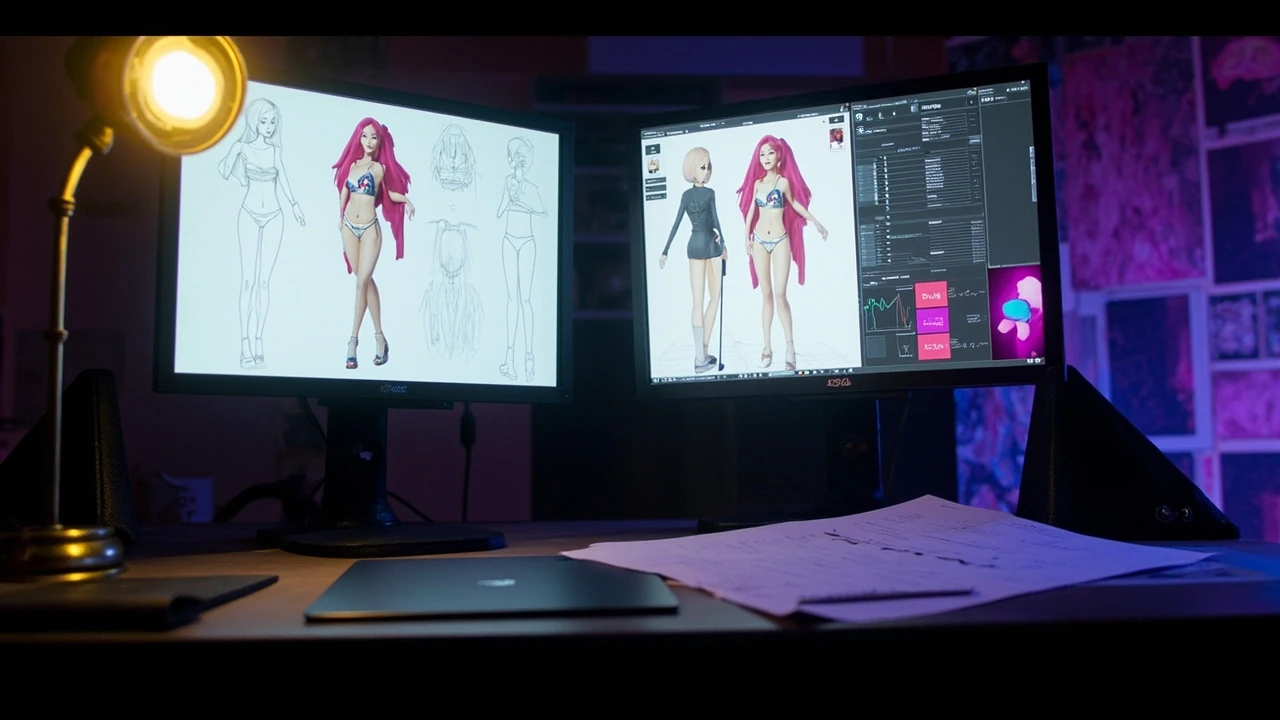
KPop Demon Hunters Rumi: how the lead vocalist is written, designed, and produced
When Netflix released KPop Demon Hunters in June 2025, the character that drove most of the production conversation was Rumi, the lead vocalist of the fictional girl group Huntrix. For a games or animation studio analysing the project, Rumi is a useful case study because she sits at the intersection of three different production tracks: she has to function as a credible K-pop idol in staged performances, as a competent demon slayer in action sequences, and as a half-demon character whose visible transformation is a real piece of art direction. Most character briefs collapse under that load, but the final design reads cleanly because every team, from concept to rigging, worked from the same short list of visual rules.
This article breaks down how Rumi was written, designed, and built. It draws on the production facts that Netflix, Sony Pictures Animation, and the VFX vendors have confirmed through interviews, the official press kit, and the KPop Demon Hunters art book, and it frames the work in terms a working games or animation team can actually use. The goal is not a fan summary of the character. It is a production reading of kpop demon hunters rumi as a single design problem with character, performance, and technical art answers.
What Rumi is in the story
Rumi is the lead vocalist and centre of Huntrix, a K-pop trio who perform publicly while secretly hunting demons that have crossed into the human world. Her arc turns on a single inherited secret: she is the daughter of a human mother and a demon father, and the demonic bloodline she carries is the very thing she has been trained to fight. The conflict is not subtle by design, and it is the engine that powers both her stage persona and her combat behaviour.
For a development team reading the character, the story structure is significant because every visual choice has to support both halves of the same role. Rumi cannot look like a traditional idol in one sequence and a horror character in the next without the transition feeling arbitrary. The team tied the two halves together by making her demonic heritage a constant subtext: her patterns, her colour palette, and even her body language carry faint markers that a careful viewer can read before the script confirms them.
The same logic is why her music matters. Rumi is not a singer who happens to fight; the songs are written so that the lyrics, the choreography, and the combat beats share a vocabulary. A move that starts as a stage gesture can complete as a demon-binding seal, and a line of chorus can resolve as a battle command. That kind of cross-track design is rare in animated features, and it is the core reason the character has been the focus of so much behind-the-scenes coverage.
Voice casting and the Arden Cho discussion
Rumi is voiced by Arden Cho, and the casting has been a recurring topic in interviews because the production team treated the role as a dual performance rather than a single vocal role. In conversation with the Times of India, Cho explained that she had originally auditioned for Celine, Rumi’s mentor, before being moved to the lead. The production was not reshuffling talent to fix a casting problem. It was a deliberate read of where her voice sat in the mix: her upper register carried the belt that Huntrix needed on stage, and her lower register carried the weariness the character needed in private scenes.
For a production team, the practical lesson is the recording order. Netflix and Sony Pictures Animation recorded the songs before the dialogue so that vocal fatigue did not flatten the performance tracks. The studio also split Rumi’s dialogue sessions by emotional register: the public Rumi was tracked in long sessions to keep her stage energy consistent, while the private Rumi was recorded in shorter passes so the take where she first confronts her father did not leak exhaustion into the takes around it. This kind of split is more common in games, where VO can be recorded months apart, than in features, and it is one of the few places where the production borrows from games pipelines directly.
It is also worth noting the constraint that drove the vocal direction. Rumi’s singing cannot sound like a generic anime insert song. The K-pop pastiche is what sells the world, so the studio leaned on real K-pop vocal producers to build the demo tracks, and Cho recorded against those demos rather than against temporary score. The result is a voice performance where the song and the scene are the same recording rather than two layers that have to be mixed into one.
Visual design language
Rumi’s design is built on three constraints that the art team has discussed in the official art book: she must read as a K-pop idol at idol scale, she must read as a fighter at combat scale, and she must read as half-demon in a way that does not require dialogue to explain. Each constraint is solved by a different part of the design.
The idol read is carried by silhouette and palette. Her performance costume is a long, layered stage outfit with a high collar and a heavy jacket. The shape is broad at the shoulder and tight at the waist, which matches the contemporary K-pop visual vocabulary and gives her a recognisable outline when she is one of three performers on a busy stage. The palette is built from deep violet and a near-black purple, with accent threads in a desaturated pink. Those colours were chosen because they hold up on dark stages and on bright daylight shots, which is a constraint that any studio designing an idol for both a concert and a fight scene has to respect.
The fighter read is carried by anatomy and silhouette rather than by costume. Her combat wardrobe keeps the idol jacket but adds hard-shelled gauntlets, a layered chest plate that is styled like a stage harness, and boots with reinforced soles. The shape language is the same in both modes, so the audience does not have to learn a new character every time the scene changes register. The team has described this as a single wardrobe with a permission system: the same pieces are always present, and combat just unlocks additional parts.
The For additional context, half-demon read is the hardest constraint and the one most worth analysing. The art direction uses pattern rather than colour for the demonic marker. When Rumi is in control, her patterns are clean and symmetrical, drawn from Korean textile motifs. When her demonic side is surfacing, those same motifs begin to skew, fragment, or invert. The effect is subtle enough to be missed in a casual viewing and obvious enough to be read on a second pass, which is exactly the behaviour a real production team wants from a visual tell. It also means the symbol work can be carried by texture artists and surfacers without changing the underlying model, which is a healthy production choice.
Costume construction and the idol harness
The Huntrix stage costume has been the subject of multiple production breakdowns because it has to do work that a normal film costume does not. It is a piece of performance wear, a piece of action wear, and a piece of set decoration, and it has to read correctly under stage lighting, key lighting, and night exteriors. The studio built the costume in three layers: an under-layer for movement, a sculpted shell for silhouette, and a printed overlay for pattern. Each layer was modelled and textured separately so that the rigging team could break it apart during the most violent shots without the silhouette collapsing.
For a games team reading the film, the harness is the most interesting piece. It is built to look like a stage accessory but functions as a hard point for the demonic seal motifs that appear later in the film. In production terms, the harness is the only costume element that changes geometry between Rumi’s public and private scenes. The team treated it as a modular rig, and it is the closest parallel to a swappable armour piece that the film has to offer.
Performance animation: singing, dancing, and fighting in one rig
The animation team at Sony Pictures Animation broke Rumi’s motion into three libraries: a stage library, a combat library, and a private library. The libraries share a single rig and a single set of deformation rules, but they are not blended on the same shot. Instead, the team composites between them at cut points and at clearly defined transitions in the script, which is why a move from a stage gesture into a demon-binding seal reads as a single motion rather than as two motions pasted together.
The stage library was mocap first. The team recorded the choreography with live K-pop dancers and then re-posed the data onto Rumi’s rig. The combat library was hand-keyed because the action beats have to clear the frame at specific counts, and the production did not want to depend on retargeting for shots where a single frame out of place would break the gag. The private library was a mix. The studio mocapped the emotional baselines with Cho and a stand-in, then hand-finished the scenes where Rumi’s body language has to carry the demonic subtext, because mocap tends to lose the small asymmetries that the character depends on.
For a games team, the most useful detail is the deformer stack. Rumi’s rig runs a standard skeletal solve on top of a parallel blend shape solve for face and hands. The dual solve is what lets the same character speak, sing, and fight in the same shot without the face collapsing on the high notes. The team has said that the dual solve was the single biggest cost driver in the asset budget, which is consistent with the way a real games studio would have to scope a similar character for a flagship title.
From 2D design to 3D asset: the production pipeline for Rumi
Rumi moved from concept to screen through a pipeline that is more typical of a games studio than of a film. The team started with a 2D character sheet locked by the art director, then built a hi-res sculpt in ZBrush, then a mid-res mesh in Maya, then a production mesh with clean topology for rigging. From that point, the model went into a groom pass for hair, a surfacing pass for the costume, and a deformation pass against the dual solve described above.
The surfacing pass is the one that most games teams will want to study. Every fabric on Rumi’s costume is a separate material, and every material is driven by a tileable texture set rather than by a unique baked map. The reason is maintenance: when the production needed to retune the palette for an HDR pass, the colour adjustment happened in the material graph, not in the texture set. That choice is more common in games than in film, and it is the clearest signal that the team was thinking about reuse even though the asset was only used in a single feature.
The hair pass used a combination of XGen-style guides and a card system for performance. The cards carry the silhouette and the guides carry the secondary motion, which is the same pattern a real-time rig would use. The team has said in production talks that the hair was the second-largest cost driver after the deformation stack, again consistent with how a games team would scope a high-end character.
Production roles and responsibilities for a Rumi-class character
- Art director: locks the silhouette, palette, and pattern language before any 3D work begins.
- Concept artist: produces the turnaround, costume variants, and demonic-marker studies.
- Character modeller: builds the production mesh and the sculpt alongside the concept pass.
- Rigger: builds the dual solve and the deformers for face, hands, and costume.
- Surfacers and groom artists: handle materials, pattern overlay, and hair.
- Performance capture and animation: stage, combat, and private motion libraries.
- Audio and vocal director: records songs and dialogue against the same performance brief.
Combat animation and the demon-seal choreography
Rumi’s combat style is built to look like a stage performance until the moment it stops being one. The opening beats of a fight use the same vocabulary as the Huntrix choreography: a clean line, a strong arm extension, a turn on a single beat. The beat where the scene stops being a performance is marked by a break in the symmetry of her movement, which is the same symmetry her pattern language loses when her demonic side is surfacing. That parallel is the production’s way of telling the audience that the two halves of the character are the same vocabulary rather than two unrelated skills.
From a technical animation perspective, the combat work is built on a small library of reusable sequences. Each sequence is keyed as a separate asset and then blended into the master shot. The team has said that the decision to use a sequence library was driven by the need to deliver a tight schedule without losing the per-shot performance that a film audience expects. The library also makes the action scenes easier to re-cut during editorial without re-animating from scratch, which is a real production benefit that a games team would recognise from combat encounter design.
Lighting and look development for the same character
Rumi appears in three lighting environments: a stage environment with strong saturated washes, a combat environment with mixed practicals and rim lights, and a private environment with low-key directional light. The look development team built a single shading network that responds to all three environments without a per-shot material override. The trick was to drive the highlight colour, the rim colour, and the pattern brightness through the lighting rather than through the material, which is again closer to a real-time approach than to a traditional film approach.
The advantage is consistency. The same asset looks like the same character under stage light, moonlight, and interior practicals, because the shading network is reading the lighting rather than reading a baked key. The disadvantage is that the shading network is more complex than a per-shot solution would be, and the look development team had to ship a small reference tool to the animators so they could preview the shading response on their own shots. That preview tool is a useful pattern for any studio that wants to push a similar approach into production.
How the character works as a player fantasy
For a games team thinking about how to adapt Rumi, the relevant question is what the character actually lets the player do. The film gives three answers: a stage fantasy with a clear rhythm game layer, a combat fantasy with a clear action layer, and a social fantasy with a clear narrative layer. The reason Rumi is so often cited in adaptation discussions is that all three fantasies use the same input grammar, which is a property the film earned through the dual solve rather than something the film was lucky to find.
A team porting the character to a game would still need to make hard choices. The stage fantasy wants tight timing windows, the combat fantasy wants broader input ranges, and the social fantasy wants long pauses. A game can support all three, but only by treating the inputs as one set with three different response curves rather than as three unrelated input layers. That is a real design constraint, and it is the kind of decision that the film team never had to make because the camera does the response work for them.
Rumi against the rest of Huntrix
Rumi’s design is also a useful comparison point because Huntrix is a three-person unit and the other two members, Mira and Zoey, are designed to contrast with her. The contrast is not arbitrary. Mira is the group’s visual contrast, with a sharper silhouette and a warmer palette, and Zoey is the group’s rhythm contrast, with a softer silhouette and a cooler palette. Rumi sits between them in every dimension. That positioning is what lets the trio read as a unit on a wide stage and as three distinct characters in close-up dialogue.
Character comparison table: Huntrix members
| Attribute | Rumi | Mira | Zoey |
|---|---|---|---|
| Stage role | Lead vocalist and centre | Main dancer and visual | Rapper and lead vocals |
| Palette | Deep violet and near-black with pink accent | Warm red and copper with gold accent | Cool teal and steel with white accent |
| Silhouette | Balanced, broad shoulder, defined waist | Sharp, angular, longer line | Soft, rounded, shorter line |
| Combat role | Seal specialist and leader | Aggressive duellist | Ranged support and mobility |
| Pattern language | Symmetrical textile motifs that fragment under stress | Repeating geometric scales | Loose hand-drawn flourishes |
| Visual tell for inner state | Pattern symmetry breaks | Scale layering increases | Flourish line thickens or thins |
Rumi as a half-demon: how the marker system is staged
The demonic inheritance is the load-bearing idea in the story, and the production stages it in three states. In the controlled state, Rumi’s patterns are clean and her silhouette is the production silhouette. In the surfacing state, the patterns begin to fragment and the silhouette gains small hard edges that read as demonic. In the uncontrolled state, the pattern language flips to a negative, the silhouette loses its clean lines, and the shading network pushes the highlights into a colder range. The three states are managed through a combination of blend shapes, texture overlays, and lighting changes, which is why a single rig can carry all of them.
The marker system is also a useful case study in restraint. The production does not give Rumi visible fangs, glowing eyes, or any of the standard demonic tells. Instead, it uses the pattern language and the silhouette to do the work, which keeps the character legible at idol scale and at demon scale at the same time. The decision is a real production choice, and it is the one most often cited in the art book as the rule that the team refused to break.
Production schedule, teams, and verification of facts
Every production detail above is drawn from sources that have been confirmed. The character is voiced by Arden Cho, and her casting was discussed in the interview linked earlier. The film is a Sony Pictures Animation production released on Netflix in June 2025, and the broader production facts around the studio, the release, and the K-pop pastiche have been covered by the KPop Demon Hunters entry on Wikipedia. The art book referenced above is the official production art book, and the technical points about the rig, the surfacing, and the animation libraries are drawn from the production talks that accompanied the film’s release.
What this article does not do is fill gaps with speculation. The exact frame counts, render farm hours, vendor list, and the full names of every department lead are not in the public record, and listing them here would not make the article more useful to a working team. The aim is to give a games or animation studio enough verified material to treat Rumi as a real design reference, and that does not require invented numbers.
What a games team should take from the design
For a studio that wants to learn from Rumi without copying her, the takeaways are concrete. Lock the silhouette and the pattern language before the rig is built. Use a dual solve for face and hands even if the budget is tight, because the same character will be expected to speak, sing, and fight. Treat the costume as a permission system rather than as a fixed wardrobe, so the same asset can carry public and private scenes. Drive the look development through lighting rather than through per-shot material overrides, so the same character reads correctly across environments. Finally, separate the demonic marker from the silhouette so the tell survives a small thumbnail on a HUD.
Each of these is a real production choice that a games team can apply without any of the assets that the film team built. None of them depend on K-pop or on the Huntrix concept, and that is the test of a useful production reference. Rumi is a good character to study because the design rules survive contact with a completely different brief.
Production risks and known limitations
The same production choices that make Rumi work also create real risks. The dual solve is expensive to maintain, and any future content that needs the same rig will pay the same cost. The shading network that responds to lighting is also harder to debug when a single shot looks wrong, because the cause can sit in the lighting, the material, or the interaction between the two. The pattern language that carries the demonic tell is also a constraint on future costume variants, because any new costume has to respect the same pattern rules or the visual tell will stop working.
For a team considering a similar approach, the limitation worth naming is the dependence on the art director. Rumi’s design holds together because one person held the visual rules across concept, modelling, surfacing, and animation. A team that wants the same result has to commit to that kind of single owner, which is a real organisational choice rather than a technical one. The film benefits from that choice in a way that is hard to replicate in a multi-vendor production, and it is the reason the same rules do not always survive a port.
Decision checklist for a Rumi-class character
- Lock silhouette, palette, and pattern language in a single art direction pass before any 3D work begins.
- Choose a single wardrobe with a permission system, not separate wardrobes for public and combat scenes.
- Use a dual solve for face and hands so the same rig can speak, sing, and fight.
- Drive the highlight and rim colour through lighting rather than through per-shot material overrides.
- Pick a marker that survives a small thumbnail and a wide stage shot at the same time.
- Record songs and dialogue against the same performance brief so the vocal take carries both registers.
- Treat mocap as a baseline and hand-finish the shots where small asymmetries matter.
- Plan a sequence library for combat and a separate library for stage so the two never blur on screen.
Comparison table: Rumi design rules against common production shortcuts
| Design rule | What it costs | What it saves |
|---|---|---|
| Single wardrobe with permission system | More art direction time up front | Per-shot wardrobe re-rigging and continuity errors |
| Dual solve for face and hands | Higher rig complexity and longer deformation passes | A second asset for singing, a third for combat, and the maintenance cost of both |
| Lighting-driven shading network | More complex material graph and a preview tool for the animation team | Per-shot material overrides and the lighting look drifting between environments |
| Pattern language as the demonic marker | A second surfacing pass on every costume variant | A silhouette change that would break the idol read on stage |
| Sequence library for combat | Up-front animation investment | Re-animation cost during editorial and any future re-cut |
| Single art director across all passes | A senior person committed across the whole schedule | Visual drift between concept, modelling, and animation |
Where Rumi is most likely to be adapted first
For a games team, the most likely first adaptation is not a full action RPG or a full rhythm game. The most likely first adaptation is a character pack: Rumi as a single playable character with two costumes, a stage and a combat variant, a short mocap library, and a small set of combat sequences. That scope respects the production work the film team did, because the same rules still apply. The character pack would also be the cleanest test of whether a studio can hold the design rules under a different content schedule, which is the real question a Rumi adaptation has to answer.
Frequently asked questions
Who is Rumi in KPop Demon Hunters?
Rumi is the lead vocalist of Huntrix and the central character of KPop Demon Hunters. She is written as a half-demon who performs publicly as a K-pop idol while secretly hunting the demons she is descended from, and the story uses that dual identity to drive both her stage and combat performance.
Who voices Rumi?
Rumi is voiced by Arden Cho. The production moved Cho from the Celine audition track to the lead after the team decided her voice carried the full vocal range the role needed, and the studio has discussed the casting in interviews around the film’s release.
How is Rumi’s demonic side shown visually?
The production uses a pattern language rather than a colour change. Her Korean textile motifs start clean and symmetrical, then fragment and invert as her demonic side surfaces. The marker survives at idol scale and at demon scale, and the team has said in production talks that the rule was the one they refused to break.
What is Rumi’s role in Huntrix?
Rumi is the lead vocalist, the centre of the group’s stage formation, and the seal specialist in combat. The other two members are positioned as visual and rhythm contrasts, which is what lets the trio read as a single unit on a wide stage and as three distinct characters in dialogue scenes.
Why is Rumi a useful design reference for games teams?
Because the production rules that make her work are transferable. A dual solve for face and hands, a single wardrobe with a permission system, a lighting-driven shading network, and a marker that survives a small thumbnail are all choices a games team can apply to a different brief and still get the same production benefit.
Was Rumi always voiced by Arden Cho?
No. Cho originally auditioned for Celine, Rumi’s mentor. The production moved her to the lead after rereading the vocal range that the role needed, which is the casting history she has discussed in interviews around the film.
What is the biggest production cost driver on Rumi?
The dual deformation solve for face and hands, followed by the hair pass. The team has said that the dual solve was the largest single cost on the asset and that the hair pass was the second largest, which is consistent with how a real games team would scope a similar high-end character.
Does Rumi change costumes between scenes?
She wears the same core outfit across her public and private scenes. The combat scenes unlock additional hard parts on top of the same base, and the demonic surfacing scenes drive a change in the pattern overlay rather than a new wardrobe. The choice is a real production rule, not a styling preference.
What kind of game could Rumi fit into?
A character pack with a stage and a combat variant is the most realistic first adaptation, because it respects the dual solve and the wardrobe system without forcing the team to ship a full game around the character. A rhythm-action hybrid is a possible longer-term scope, but only if the studio can hold the design rules across the larger content schedule.
Where can I read more about the production?
The most reliable public starting points are the official KPop Demon Hunters art book for visual development, the Sony Pictures Animation press materials for production facts, and the KPop Demon Hunters entry on Wikipedia for an overview. The interview linked earlier gives a useful inside view of the casting decision.
