
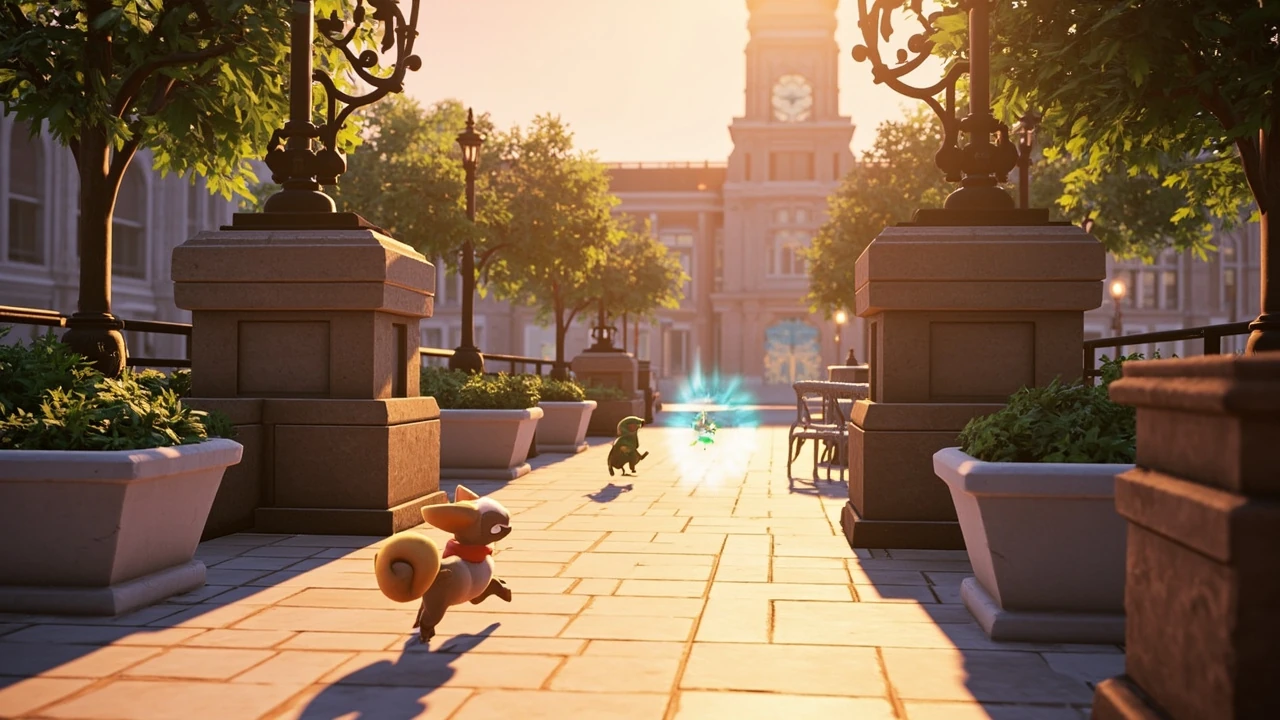
Wild Zone 16 in Pokémon Legends: Z-A
A wild zone in Lumiose City is a curated habitat where Pokémon live inside an urban redevelopment zone, and the city treats each one as a sandbox for a different encounter problem. Wild Zone 16 is the kind of zone where the team can test real-time timing, positioning and Mega Energy pacing against a small roster that punishes sloppy spacing. From a production standpoint it is also a useful reference case for how Game Freak balances a dense, narrow map against the Switch and Switch 2 performance budget, and how designers reuse the same battle rules across the entire Z-A Royale.
This guide treats Wild Zone 16 as a field study rather than a checklist. The aim is to give developers, technical designers and curious players enough context to read the encounter design, recognise the patterns Game Freak used elsewhere in the city, and ask better questions of their own open-world systems.
What a Wild Zone actually is in Z-A
From a design perspective the Wild Zone system in Z-A collapses several older Pokémon systems into one urban model:
- Routes become park blocks, plazas, construction sites and canal edges inside Lumiose.
- Day and night toggle whether the same space acts as a passive habitat or as a contested Battle Zone.
- Encounter tables are still curated per zone, but they share a city-wide battle system based on positioning, timing and Mega Energy rather than on a turn-based menu.
Wild Zone 16 inherits all of those constraints. Anything you can do in a Wild Zone, you can attempt there. Anything the city-wide system does not allow, no Wild Zone can deliver on its own.
The real-time battle system Wild Zone 16 runs on
Every Wild Zone feeds into the same real-time combat system. According to the verified game summary, “Legends: Z-A uses a real-time combat system that takes into account the positioning of the player character, their Pokémon, and the timing of used moves, and allows Pokémon to move around and dodge attacks while in a battle.” That sentence defines the three inputs every encounter in Wild Zone 16 will test: player position, Pokémon position and the timing window of the chosen move.
For developers reading the game, the practical consequences for any zone are:
- Spawns are visible in the world rather than hidden behind random tall grass.
- Move selection still exists, but it competes with movement and dodge timing for the player’s attention.
- Dodgeable moves make spacing meaningful, which in turn makes cover, sight lines and arena shape matter at the level-design layer.
Mega Energy is the second pillar. “During Pokémon battles, the player can collect Mega Energy in order to temporarily Mega Evolve their current Pokémon.” In a Wild Zone, that means designers must scatter Mega Energy sources at a density that lets a curious player experiment without trivialising the city’s boss fights and Rogue Mega encounters.
Why this matters specifically in Wild Zone 16
Smaller Wild Zones tend to amplify these mechanics because there is less room to disengage. A wild Pokémon in Wild Zone 16 is rarely far from a wall, a planter, a parked car or a building edge, which means dodge timing, line-of-sight and arena shape carry more weight than they do in an open field. The lesson for a developer studying the zone is that urban encounter design is essentially arena design, just with architecture that you cannot fully control.
Night, the Z-A Royale and how Wild Zone 16 changes role
At night, “the player can compete in a competition called the Z-A Royale by entering a Battle Zone. In Battle Zones, the player can launch pre-emptive strikes on opposing trainers that wander around, while opposing trainers are capable of the same technique and can stun the player’s Pokémon for a few seconds.” That single paragraph is the reason a day visit and a night visit to the same Wild Zone feel like two different prototypes.
Wild Zone 16 in daytime is a quiet encounter sandbox. The same Wild Zone 16 at night is a contested zone where a wandering trainer can pre-empt you and your Pokémon can be stunned. The map does not change. The rules layer does.
For a player, the practical effect is that you should not evaluate the zone from a single time of day. For a developer, the practical effect is that day and night in Z-A are not a visual toggle, they are a separate simulation mode that reuses the same level geometry.
How Wild Zone 16 fits the wider Z-A Royale
The wider Z-A Royale frames everything in Wild Zone 16. The verified story summary is explicit: “The player character’s goal is to advance from Rank Z to Rank A via promotion battles with certain trainers to have a wish granted.” A Wild Zone is where you train, gather Mega Energy, learn the real-time battle system, and occasionally run into a Rogue Mega Evolved Pokémon on your way to the next promotion battle.
| Phase of play | Where Wild Zone 16 sits | Main mechanic exercised |
|---|---|---|
| Rank Z and early ranks | Frequent re-entry, low-stakes duels | Positioning, move timing, basic dodges |
| Mid ranks, story focus | Path between story beats and promotion battles | Mega Energy pacing, team rotation |
| Late ranks, post-game | Farming, Rogue Mega preparation | Burst damage windows, longer combos |
That progression shape is what makes the city feel readable. A Wild Zone is not an open-world checklist, it is a tier of the same combat tutorial, repeated in different architectural settings until the player is ready for the Prism Tower and the final boss cycle.
Mega Energy economy around Wild Zone 16
Mega Energy is the visible resource that connects every Wild Zone to every other system in the game. The summary describes it as a resource “collected” during battles and “temporarily” used to Mega Evolve the current Pokémon. In a tight urban zone like Wild Zone 16 that economy is more compressed than it is in a larger habitat. Energy sources, restocking patterns and the cost of Mega Evolving each species all read differently when the loop is short.
From a developer perspective the questions to ask of any small Wild Zone are:
- How long is the loop from entering the zone to spending Mega Energy on a single Pokémon?
- Is there a safe retreat point, or does the loop assume combat commitment?
- Are there enough Mega-capable species in the zone to justify a Mega investment, or is Mega Energy here just a top-up source on the way to a bigger zone?
You will not get an exact number for Wild Zone 16 from the verified summary because the page only describes the system, not the per-zone economy. A reader looking for an authoritative count should wait for an in-game or official source, since publishing a fabricated rate would be guessing.
Wild Zone 16 as an open-world design case study
Most open-world systems fail at the seam between “city as backdrop” and “city as playable space.” Z-A commits to the second reading for the whole of Lumiose, and Wild Zone 16 is one of the smaller tiles in that commitment. Studying it as a design case gives a developer a compact example of:
- How a small encounter sandbox can co-exist with a story-driven progression system.
- How the same level can act as a daytime habitat and a night-time PvE zone without reloading.
- How a real-time battle system interacts with tight architecture, where cover and sight lines matter more than raw arena size.
That is also why comparisons with the studio’s other recent city-style work, including Pokémon Legends: Arceus, are limited. Arceus used a hub area at the start and a series of open biomes; Z-A uses a single city block, repeated. The encounter design implications are different at every level.
Wild Zone 16 and the multiplayer layer
The Wikipedia article on Pokémon Legends: Z-A describes Lumiose City as a single large map “where Pokémon coexist with humans in locations known as Wild Zones.” That single sentence is the entire mechanical contract. A Wild Zone is a designated sub-area of a real city where wild Pokémon spawn, where trainers can enter freely during the day, and where the night-time Z-A Royale turns the same space into a Battle Zone with wandering opponents.
The verified description of the multiplayer “Battle Club” applies to Wild Zone 16 only in the sense that a player can use the zone while connected. The summary describes the Battle Club as a separate mode “where up to 4 players can participate in Link Battles to defeat the most Pokémon in a given time period, or Ranked Battles, where players battle each other directly for rank points and earn exclusive Mega Stones upon reaching certain ranks.”
For Wild Zone 16, the relevant takeaway is that online play does not redesign the zone. Link Battles and Ranked Battles use the battle system but not necessarily the Wild Zone geometry. A developer reading the game should treat the Wild Zone as the single-player and local layer, and the Battle Club as a separate competitive layer that borrows combat rules without inheriting the city layout.
Pokémon Home and the Wild Zone 16 roster
The same summary notes that the game “supports the Pokémon Home online cloud storage app, allowing transfers of supported Pokémon from” several earlier titles, while warning that “all supported Pokémon transferred to Legends: Z-A cannot be returned to those games.” A Wild Zone is one of the few places in the game where a transferred Pokémon can be observed behaving exactly like a native one.
The practical implication is that a Wild Zone roster is not just a static encounter table. It is also a compatibility surface, because every transferred Pokémon has to function in the real-time system and respect the same dodge, position and Mega Energy rules. If a species is awkward to use in Wild Zone 16, that awkwardness usually traces back to the combat layer rather than to the zone itself.
Performance, hardware and Wild Zone 16 on Switch 2
The summary states that the game was originally announced “as an exclusive to the original Switch console, before it was later announced that it would also receive an enhanced port for the Switch 2.” The first-party performance budget for Z-A is therefore split between two very different hardware targets, and small Wild Zones are exactly the kind of area where a port team can test character density, Mega VFX and shadow costs without reloading a large biome.
For a developer working on similar ports, Wild Zone 16 is a reasonable stress case to instrument:
- Many small spawns in close quarters, which stresses crowd update and instancing rules.
- Short player-to-camera distances, which stress LOD swaps and material streaming.
- Mega VFX firing in a tight space, which is a typical worst case for overdraw on a Switch-class GPU.
Specific frame-rate numbers are not part of the verified summary, so any “Switch 2 runs Wild Zone 16 at X fps” claim is editorial. Treat such numbers as targets to validate on a build rather than as facts.
Where Wild Zone 16 sits in the DLC story
The summary describes the paid DLC, Pokémon Legends: Z-A – Mega Dimension, as moving the team into “Hyperspace Lumiose” and introducing new Rogue Mega Evolved encounters, with Mythical Pokémon such as Darkrai and Hoopa driving the story. Wild Zone 16 is part of base-game Lumiose, not Hyperspace Lumiose, so the DLC changes the city around it rather than inside it.
For a developer the relevant detail is structural: the base game reuses one large map many times, while the DLC introduces a parallel dimension that still respects the same real-time battle system. That is a useful pattern for any team that wants to extend an open-world city without re-authoring the city from scratch.
Common misunderstandings about Wild Zones in Z-A
Because the Wild Zone concept is new to the mainline series, several reader questions keep coming up. The verified summary only directly addresses some of them, so the table below separates what the page actually supports from what is plausible but unverified.
| Reader assumption | What the verified summary says | Safe reading |
|---|---|---|
| A Wild Zone is a route replacement. | Wild Zones are “locations” inside Lumiose where Pokémon “coexist with humans.” | Routes and Wild Zones both host wild encounters, but a Wild Zone is a city block, not a road between cities. |
| Wild Zones are always PvE. | Battle Zones “appear” at night and “opposing trainers are capable of the same technique.” | Day is usually PvE, night is contested by trainers as part of the Z-A Royale. |
| Wild Zones use a turn-based battle system. | The game “uses a real-time combat system” that “takes into account the positioning.” | All Wild Zone encounters use the real-time system, including Mega Evolution. |
| You can keep transferred Pokémon forever. | “All supported Pokémon transferred to Legends: Z-A cannot be returned to those games.” | Pokémon Home transfers are one-way for Z-A, so treat the Wild Zone roster as a permanent roster. |
| Wild Zones change in the DLC. | The DLC adds Hyperspace Lumiose, a parallel dimension. | Base-game Wild Zones remain; Hyperspace Lumiose is an additional space. |
The pattern is the same in every row. The verified source lets you describe the system, but specific numbers, spawn lists and difficulty ratings are not in that summary and should not be invented from it.
What a developer can take into a similar project
Wild Zone 16 is small enough to read in a single sitting, which makes it a good reference for any team that is thinking about urban encounter design. The lessons that survive the move to a different engine or IP are:
- Treat the day-night cycle as a system toggle, not a visual effect. Day and night should change rules, spawns and the player’s safe engagement radius.
- Anchor your resource economy to a small, named zone, then test it at that scale before letting the economy grow with the map.
- Design cover and sight lines before encounter tables. In a real-time combat system, the geometry usually matters more than the spawn list.
- Keep one combat system across PvE, PvE-versus-AI and any ranked mode. Wild Zone 16 is legible precisely because it does not switch engines between day and night.
None of that depends on Pokémon branding. It depends on the structural choices that Game Freak made visible in the Wild Zone system, and on the way the same system reappears in the wider Z-A Royale.
Practical questions to ask of any Wild Zone
If you are playtesting Wild Zone 16 or auditing your own city, the same questions tend to surface the design intent:
- What is the shortest loop from entering the zone to spending Mega Energy on a Pokémon, and is that loop short enough to be fun on a first visit?
- Where can a player safely disengage, and is that safe space visible from the encounter trigger?
- How does the zone teach a new player the real-time timing window without signposting the dodge explicitly?
- What changes about the zone at night, and is that change obvious to a player who has only seen daytime?
- If the zone were the smallest in the city, would a player still choose to revisit it for a specific reason?
A Wild Zone that fails two or more of these is usually a zone where the city is carrying it, not the design. A Wild Zone that passes them is the kind of small tile that quietly carries a whole open-world city.
Where Wild Zone 16 leaves the player
The verified summary is clear that the larger arc ends with the destruction of the device “Ange” inside Prism Tower, with the player watching AZ die shortly after, and with Taunie/Urbain and the player agreeing to use their wishes to restart the competition as the “Infinite Z-A Royale.” Wild Zone 16 is part of the world that arc runs through, not the arc itself.
For a player the lesson is to treat the zone as a permanent part of the post-game city, the way a real park would remain after a festival ended. For a developer the lesson is that an open-world system can survive a story climax only if the smaller spaces still hold their own weight once the camera moves on. Wild Zone 16 is one of the smaller spaces that does.
Frequently asked questions
What is Wild Zone 16 in Pokémon Legends: Z-A?
Wild Zone 16 is one of the named sub-areas inside Lumiose City where wild Pokémon live alongside humans. The verified game summary describes Wild Zones as “locations” within Lumiose where Pokémon “coexist with humans,” and during the day they act as encounter sandboxes that feed the real-time battle system the rest of the city shares.
Is Wild Zone 16 the same as a Battle Zone?
No. A Wild Zone is the underlying habitat. According to the verified summary, “Battle Zones” appear only at night as part of the Z-A Royale, when “opposing trainers wander around” and can pre-empt the player. A Wild Zone such as Wild Zone 16 is therefore the day and the night location; a Battle Zone is a specific night-time state of that location.
Does Wild Zone 16 use the real-time battle system?
Yes. The summary says that “Legends: Z-A uses a real-time combat system that takes into account the positioning of the player character, their Pokémon, and the timing of used moves.” Wild Zone 16 runs on that system, including Mega Evolution, because every encounter in the game uses the same combat rules.
Can I use Mega Evolution in Wild Zone 16?
Yes. The summary states that “during Pokémon battles, the player can collect Mega Energy in order to temporarily Mega Evolve their current Pokémon.” The Wild Zone is one of the places where that energy economy is easiest to read, because the loop between collecting and spending is short.
Do trainer battles happen in Wild Zone 16?
They can. At night, the same area is a Battle Zone and trainers “wander around” while “opposing trainers are capable of the same technique” and can stun the player’s Pokémon. Daytime encounters are mostly wild Pokémon, while night-time encounters add trainers on top of the same map.
Is Wild Zone 16 in the base game or the DLC?
Wild Zone 16 is part of base-game Lumiose City. The DLC, Pokémon Legends: Z-A – Mega Dimension, adds a parallel space called Hyperspace Lumiose and new Rogue Mega encounters; the base-game Wild Zones remain, but the DLC content lives in a different dimension rather than rewriting the city.
Can I use Pokémon Home transfers in Wild Zone 16?
Transferred Pokémon can be used in the game, and therefore in Wild Zone 16, but the summary is explicit that “all supported Pokémon transferred to Legends: Z-A cannot be returned to those games.” Treat the Wild Zone 16 roster as a permanent roster, because transfers into Z-A are one-way.
Does Wild Zone 16 change between Switch and Switch 2?
The verified summary confirms an enhanced port for the Switch 2 but does not give a per-zone feature list, so it is safest to assume that Wild Zone 16 plays the same on both platforms with differences limited to resolution, frame rate and possibly draw distance. Specific performance numbers for the zone are not in the verified text and should be checked against a real build.
Is Wild Zone 16 good for farming Mega Energy?
The summary describes Mega Energy as something “collected” during battles, but it does not give a per-zone rate, so the verified text does not support a specific answer. The structural argument is that a small Wild Zone will feel more efficient for short loops, while a larger zone will feel more efficient for longer runs; either way, the rate itself is something only an in-game test or an official source can confirm.
Where does Wild Zone 16 sit in the Z-A Royale progression?
Wild Zone 16 is one of the recurring habitats the player uses between promotion battles on the way from “Rank Z” to “Rank A.” The wider Z-A Royale uses those zones as the training ground for the real-time battle system, and the same zones remain useful after the story for Mega Energy, Rogue Mega preparation and Infinite Z-A Royale attempts.
