
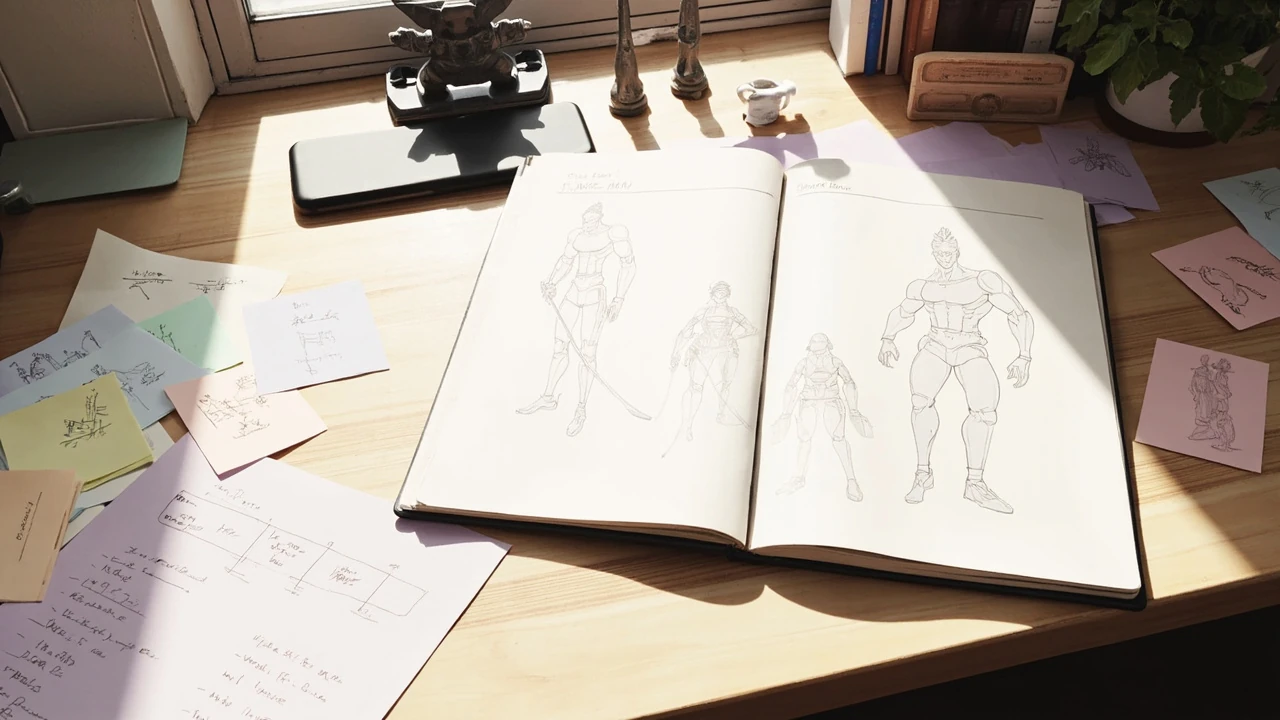
Anime ranger x code: how to design a tier-based ranger system that holds up in playtest
Designing an anime ranger x code system usually starts with a familiar question: how do you let a player feel like the strongest version of their class without collapsing every encounter into a single best build? The temptation in anime-style action games is to copy a popular franchise’s identity curve, then bolt on a spreadsheet of multipliers. That approach almost always fails in playtest because the multipliers were tuned for a different combat loop, a different enemy density, and a different camera than the one you are shipping. A better starting point is to decide what the ranger is supposed to do at rank one, what the rank-up moment should feel like, and what the player must trade away to reach the top tier. Once those three decisions are written down, the rest of the anime ranger x code implementation becomes a set of constraints rather than a wish list.
This article is written for game designers, technical designers, and small-studio leads who are building or extending an anime-styled action game, a roguelite, a gacha, or a hero collector that uses a ranger archetype. It focuses on the design and engineering decisions behind a tiered ranger system, the variables you actually have to balance, the order in which you should implement them, and the validation steps that tell you whether the system is healthy before you commit to a content roadmap.
What an anime ranger x code system is, in design terms
Inside a development team, an anime ranger x code is shorthand for a layered character progression package that combines a class identity, a tier ladder, an ability loadout, and a set of progression gates. It is not just a numeric curve. It is the bundle of rules that says: when a player enters a stage, they should know what their ranger can do, what they cannot do yet, and what they have to accomplish to unlock the next layer of power. If those three answers are clear, the system has a chance of feeling rewarding. If any of them is fuzzy, the player feels lost and the design feels grindy even when the numbers are reasonable.
For clarity, the rest of this article uses the phrase “tiered ranger system” interchangeably with anime ranger x code, because that is how most internal design documents will describe it. The point of the code, in the designer’s sense, is to make the ranger legible, expressive, and tunable, in that order.
Core design pillars of a tiered ranger system
Before any numbers are written, you need a small set of pillars that every later decision can be checked against. Pillars are not features; they are the qualities the system must preserve when scope, art, and schedule pressure the team to compromise.
| Pillar | What it means in play | What it forbids | How to test it |
|---|---|---|---|
| Legibility | Player can describe their ranger’s role after one match. | Hidden passive stacks, off-screen buffs, unnamed modifiers. | Five-player usability test, no hints, five-minute debrief. |
| Expressiveness | Two rangers of the same tier can feel different based on loadout. | One dominant build per tier, mandatory traits. | Pairwise build comparison across two content patches. |
| Tunability | Any single tier or ability can be adjusted without rewriting others. | Cross-tier hard-coded multipliers, baked-in assumptions. | Designer can change a value and rebuild in under five minutes. |
| Progression honesty | The cost of reaching the next tier is visible before the player commits. | Hidden grind walls, surprise resource walls at rank-up. | Run a full progression from rank one to max on a fresh save. |
If your current prototype violates any of these pillars, fix that before adding more content. Adding more tiers or more abilities on top of an illegible system only makes the illegibility worse.
Tier structure: how many ranks make sense for an anime ranger
Tier count is the single most consequential decision in a tiered ranger system, because it sets the rhythm at which the player experiences new power. Too few tiers, and the game feels like a flat stat block. Too many, and each rank-up loses meaning because the player is always one step away from another one.
Choosing the rank count for your content cadence
For most anime-style action games, a three-tier or four-tier ladder is the right starting point. Three tiers give you a clear arc: a base form that the player learns, a mid-tier transformation that introduces a new mechanic, and a final form that reframes the earlier abilities. Four tiers work when you have a real second transformation moment, such as a late-game class branch, and you can give it a distinct mechanical identity rather than just larger numbers.
- Use three tiers when the campaign has one clear climax and one post-game loop.
- Use four tiers when the player changes roles between early, mid, and late game, and you have the budget for two distinct transformation cinematics.
- Avoid five tiers or more unless the game is explicitly built around prestige or seasonal rank resets.
- Treat the final tier as a “crescendo,” not as a default play state. If the player spends most of their time at max rank, the lower tiers are wasted design work.
What each tier should introduce mechanically
Each rank should add at least one new verb to the player’s kit, not just a numeric increase. A new verb is something the player can do at rank two that they could not do at rank one, such as a wall run, a charged arrow, a companion summon, or a stance switch. Numeric scaling is necessary, but it should be a side effect of the new verb rather than the headline.
| Tier | Headline addition | Secondary effect | Common risk |
|---|---|---|---|
| Rank 1: Initiate | Core weapon and basic ability. | Tutorial-grade combo chain. | Player outgrows it before reaching the first real boss. |
| Rank 2: Adept | One new mobility or utility verb. | Resource pool expands. | New verb is overshadowed by a buffed rank 1 ability. |
| Rank 3: Vanguard | Ultimate ability or transformation burst. | Combo routes branch. | Ultimate is so strong that lower-tier content feels trivial. |
| Rank 4: Paragon (optional) | Role shift or specialty branch. | Build-defining passive slot. | Players feel forced to regrind to stay relevant. |
A useful internal sanity check is to write one sentence per tier that says “at this rank, the ranger can now ___.” If you cannot fill that sentence for a tier, that tier does not have a real identity and should be cut or merged.
Ability loadout design for an anime ranger x code
Once the tier ladder exists, the next layer is the ability loadout. Anime ranger kits are usually presented as a set of named abilities tied to a resource bar. From a design perspective, you are building a small set of states and a budget that governs how often the player can enter each state.
Designing the ability budget
The ability budget is the total resource the player has per encounter to spend on their signature moves. It has three parts: the resource that regenerates during combat, the resource that is consumed by each ability, and the recovery time after an ability is used. All three must be tuned together; tuning only one of them tends to produce builds that feel either endless or starved.
- Regeneration rate should be readable on screen, even if only as a bar that fills.
- Each ability’s cost should be a meaningful fraction of the bar, not a rounding error.
- Recovery time should punish spamming without making the ability feel like a once-per-match event.
- Ultimate-tier abilities should cost more than they regenerate in a single normal encounter, so that the player has to choose when to spend them.
A common mistake is to let the regeneration curve outpace the cost curve, which makes the player feel rich and every encounter identical. A better pattern is to keep the regeneration curve just under the cost curve during normal play, and let the player exceed it only when they chain a successful combo or complete an objective. This produces moments of “earned power” that the anime genre is known for, without making the design trivial.
Loadout slots and switching rules
Most anime rangers ship with three to five ability slots. The slots should not all be interchangeable. A reasonable split is one signature ability, two utility abilities, and one ultimate slot. The signature ability is always present and defines the class. Utility abilities can be swapped between encounters to support different enemy mixes. The ultimate slot has a longer cooldown and is reserved for boss or story beats.
| Slot | Role | Swap rules | Tuning concern |
|---|---|---|---|
| Signature | Class identity move. | Locked for the run. | Must work in every encounter archetype. |
| Utility A and B | Coverage, mobility, or control. | Swappable between encounters. | Avoid a single utility that obsoletes the other. |
| Ultimate | Crescendo, transformation, or finishing move. | Locked for the run, long cooldown. | Should not trivialize non-boss content. |
| Passive slot (optional) | Build-defining modifier. | Selected at rank-up. | Keep passives additive, not multiplicative, unless you can afford the math risk. |
Progression economy: how the player pays for rank-up
The progression economy is the part of an anime ranger x code design that decides what the player has to do in order to unlock the next tier. It is also the part most likely to be copied from a competitor without checking whether the rest of the system can support it.
Resource types and where they should come from
A tiered ranger system usually needs two to three progression currencies: a general one earned across the game, a class-specific one earned by playing as the ranger, and an event or story one tied to specific encounters. The general currency is for cosmetic and side upgrades. The class currency is the gate for tier-up. The event currency is for story-locked content so the player cannot bypass the campaign.
- General currency: drops from any combat, used for consumables and cosmetics.
- Class currency: drops only from ranger-class activities, used to unlock the next tier.
- Event currency: drops only from the encounter or story beat it is tied to, used for cinematic and signature gear.
Avoid adding a fourth currency unless you have a clear role for it. Every extra currency is a tab the player has to read, and most players will not read more than three.
Pacing the cost curve
The cost to reach the next tier should rise faster than the rate at which the player earns the class currency in the same content. If the costs rise in a straight line, the player will feel the grind at the end of the ladder and lose interest. If the costs rise exponentially, mid-game players will feel starved. A workable pattern is a stepped curve: each tier has a flat cost, then a small bump at the start of the next tier, then another flat segment. This produces visible checkpoints and a sense of motion without a runaway curve.
| Tier transition | Cost shape | Player feeling |
|---|---|---|
| Rank 1 to 2 | Low and flat. | “I’m getting stronger quickly, the system makes sense.” |
| Rank 2 to 3 | Step up, then flat. | “I have a goal and I can see it.” |
| Rank 3 to 4 (if used) | Higher step, longer flat. | “This is endgame, I am working toward the final form.” |
| Post-max content | Prestige or seasonal, not vertical. | “I am replaying for variety, not for another number.” |
Encounter design for a tiered ranger
Encounter design and tier design have to be developed together. A tiered ranger who has just unlocked a new mobility verb needs an encounter that demands that verb, otherwise the player never learns to use it. A tiered ranger at max rank needs encounters that are not trivial, otherwise the system feels like it collapsed.
Encounter archetypes that match ranger verbs
For each new verb added at a tier, you should have at least one encounter archetype that requires it. This is sometimes called a “showcase encounter” and it is the most reliable way to teach a new ability without writing a tutorial pop-up.
- Rank 1 showcase: a mixed mob that rewards the signature ability’s basic timing.
- Rank 2 showcase: a vertical or wide arena that demands the new mobility verb.
- Rank 3 showcase: a boss with a phase change that creates an opening for the ultimate.
- Rank 4 showcase (if used): a multi-objective encounter that needs the build-defining passive.
Designing enemy density for the ranger kit
Anime rangers are usually best against single high-value targets or small groups. They tend to struggle when forced into crowd control. If your encounter design puts the ranger in a crowd, you need to give the kit an explicit answer for that, either through a wide-cleave ability, a companion summon, or a trap. Without an explicit answer, the player will feel that their class does not work, which is a structural problem, not a balance problem.
A practical rule is to never place the ranger in a crowd larger than the number of targets their cleave can hit in one use, unless the encounter also drops a resource that lets the player spend an ultimate or a utility ability to thin the group. This is one of the constraints the system imposes on level design, and it is the kind of constraint you want to write down early.
Technical implementation notes for a tiered ranger system
The implementation side of an anime ranger x code is where a clean design either survives or breaks. The good news is that most tiered systems can be built on a small set of data structures, as long as the data is separated from the abilities and the abilities are separated from the visuals.
Data structures you will need
At minimum, you need a tier definition, an ability definition, a loadout definition, and a progression definition. Each should be a data asset, not a class, so that designers can change them without engineering involvement after the schema is in place.
- Tier definition: rank index, unlock requirements, stat multipliers, and which abilities become available.
- Ability definition: cost, cooldown, hit data, VFX and SFX hooks, and any state transitions it triggers.
- Loadout definition: which ability IDs are in each slot, and the rules for swapping them.
- Progression definition: which currencies feed which unlock, and the cost curve for each transition.
Pseudocode pattern for a tier-aware ability
The following pseudocode is illustrative, not a tested engine API. It shows the shape of a tier-aware ability check, which is the part most likely to grow messy if you do not separate tier gating from ability logic.
function CanUseAbility(player, abilityId):
 ability = AbilityDB.Get(abilityId)
 tier = player.currentTier
 if tier < ability.minTier:
 return DENY_TOO_LOW_TIER
 if player.resource < ability.cost:
 return DENY_NOT_ENOUGH_RESOURCE
 if ability.cooldownRemaining > 0:
 return DENY_ON_COOLDOWN
 return ALLOW
The pattern keeps three checks in one place. As you add more tiers or more abilities, you extend the data, not the function. The same function is called by AI, networking, UI, and input, so it has to be authoritative on the server, not just on the client.
Common implementation pitfalls
There are a few recurring failure modes in tiered ranger code that are easier to avoid than to fix later.
- Tier multipliers baked into ability formulas: any time you see a multiplier inside an ability that points back to the tier, the system is fragile. Move the multiplier to the tier definition and pass it in.
- Hidden hard-coded thresholds: bosses or encounters that secretly assume the player is at a specific tier. Always expose the assumption in the encounter data.
- Client-only authority: in any game with online play, tier checks must be enforced on the server. The client is for visuals, not for gating.
- Save data drift: when you change the tier schema between patches, old saves need a migration path. Plan for that before the first public build.
Validation: how to test a tiered ranger before you scale it
You cannot tune a tiered ranger system from spreadsheets alone. You need a small set of validation passes that each answer one question, and you need to run them on a representative build, not on a feature branch nobody else can see.
Internal playtest checklist
Use this checklist on a build that has at least two tiers implemented. If you cannot pass the checklist at two tiers, do not add a third.
- A new player can describe the ranger’s role after one five-minute match.
- A returning player can list the differences between rank 1 and rank 2 without looking at a menu.
- The rank 2 ability is used by at least half of testers in their second match.
- No single ability is responsible for more than 60 percent of the ranger’s total damage in a standard encounter.
- The cost to reach rank 2 takes between two and four standard encounters to earn.
Telemetry signals worth collecting
Once the game is in a wider test, the cheapest validation is a small set of telemetry events. Do not over-collect; the goal is to answer the design questions, not to build a data warehouse on day one.
| Event | Question it answers | Threshold to watch |
|---|---|---|
| tier_up_completed | How long does a tier take in real play? | If rank 2 takes more than twice the design target, the economy is off. |
| ability_used | Which abilities are actually used? | Any ability used by less than 10 percent of players in a session is a candidate for rework. |
| encounter_failed | Where does the system break? | Failures clustered at one rank suggest the encounter, not the player, is wrong. |
| loadout_swapped | Are utility slots meaningful? | If less than 20 percent of players ever swap, the slot is decorative. |
Common design questions for anime ranger x code systems
Below are practical questions that come up repeatedly when a team starts building or extending a tiered ranger system, with the kind of answers that hold up in code review and design review alike.
Should the final tier be a transformation or a stat peak?
A transformation is almost always the better answer, because the player is paying for a visual and mechanical identity shift, not just a number. A stat peak can be a stopgap for early prototypes, but if the final tier only changes numbers, the player will feel that the game ended one tier early. The transformation does not have to be expensive, but it should change at least one input mapping, one ability behavior, and one piece of the player’s UI.
How do you keep the lower tiers relevant at max rank?
The lower tiers stop being the player’s loadout but should still be the player’s vocabulary. The cleanest way to do that is to have the max-tier kit reference the earlier abilities, for example by upgrading them, chaining into them, or letting the player enter the lower-tier state briefly as a tactical option. If the lower-tier abilities disappear entirely at max rank, the player will not feel that they grew; they will feel that the game swapped their character.
How much should abilities cost relative to each other?
A useful starting point is to make the ultimate cost twice the most expensive utility, the most expensive utility cost twice the signature, and the signature cost the smallest meaningful fraction of the bar. This is not a law; it is a starting curve that gives the player a clear hierarchy. After the first playtest, the cost order will probably stay but the absolute numbers will change, which is a healthier sign than having to rebuild the cost structure from scratch.
What is the role of cosmetics in a tiered system?
Cosmetics should not be required to make the system feel complete. They are the layer that lets the player express identity without affecting balance. The mistake is to put a meaningful gameplay modifier behind a cosmetic gate, because then the cosmetic is no longer a cosmetic and the player will resent it. A workable rule is to keep the first version of each tier’s look free, and reserve alternate looks for currency or event rewards.
Where the anime ranger x code meets the rest of the game
A tiered ranger system does not stand alone. It sits on top of the combat system, the encounter system, the economy, and the content pipeline. When it works, the rest of the game feels like it has a backbone. When it fails, the rest of the game starts to feel like a series of unrelated encounters, because the player no longer has a clear sense of where they are in their own progression.
That is why the most useful internal document for an anime ranger x code is not a balance spreadsheet. It is a one-page design brief that lists the pillars, the tier ladder, the ability budget, the progression economy, and the validation checks. If the team can keep that brief honest, the system has a much higher chance of surviving contact with real players.
For studios that are scoping a new project around an anime-styled ranger, the next step is usually a small vertical slice that contains one tier, one encounter archetype, and one boss. If that slice is fun and legible, the rest of the tier ladder can be built on top of it. If it is not fun and legible, adding more tiers will not save it. That decision point is the single most important one in the early life of the system, and it is worth treating as a milestone rather than a guess.
Frequently asked questions
What does anime ranger x code mean in a design document?
In a design document, anime ranger x code is shorthand for the bundle of rules that defines a tiered ranger class: the tier ladder, the ability loadout, the resource budget, the progression economy, and the encounter expectations. It is the contract between combat, progression, and content teams. The phrase is convenient because it covers all of those layers in two words, but it is not a system by itself; it is the description of a system.
How many tiers should a tiered ranger have at launch?
For most anime-style action games, three tiers at launch is the right starting point. Four is reasonable if you have the content to support a second transformation moment. More than four is usually a sign that the team is trying to use vertical progression to solve a content pacing problem, which is better solved with horizontal content such as new encounters, new abilities within an existing tier, or a seasonal structure.
Should the final tier be unlocked by story or by grind?
Story is the safer default for a single-player or narrative-led game, because the final tier is a narrative beat as much as a power beat. Grind is acceptable in a live service game where the player is expected to revisit the ladder across seasons. A hybrid approach, where the final tier is story-gated but the cosmetics around it are grind-gated, lets the system serve both audiences without compromising either.
How do you prevent one build from dominating the ranger kit?
You prevent a dominant build by making the design space large enough to support more than one viable path, and by validating with telemetry after launch. On the design side, that means giving each ability a real role, avoiding multiplicative passives, and not having one ability that is also the others’ upgrade. On the validation side, it means watching the ability usage and damage share data and acting on it within a patch or two, before the dominant build becomes the community’s only build.
What is the role of the ranger’s companion, if any?
A companion, when present, is a force multiplier for the ranger’s role, not a separate character the player has to learn. The companion should do something the ranger cannot do alone, such as marking targets, drawing aggro, or providing a single-target heal, and it should be controlled by the ranger’s ability budget, not by a separate set of inputs. If the companion needs its own UI, its own resource, and its own upgrade tree, it is a second character and should be designed as one, with its own tier ladder and its own progression economy.
How do you handle balance changes without invalidating player progress?
You treat balance changes as changes to the live values, not to the player’s unlocked state. The abilities the player has unlocked stay unlocked; the numbers, cooldowns, and effects change. The most reliable way to do this is to keep the player’s loadout as a list of ability IDs and tier IDs, and to keep the actual data in a versioned database. When a balance patch ships, only the database changes, and the player’s loadout resolves against the new data on next login.
Can a tiered ranger system work in a multiplayer game?
Yes, but it requires the server to be the source of truth for tier and ability checks. The client can predict, but it cannot grant. In team-based modes, the tier ladder is also a balancing variable, so the matchmaking system may need to widen the allowed tier range or to grant mid-match tier-ups. The most common mistake in multiplayer is to assume that a player at rank 3 and a player at rank 1 can coexist in the same match without server-side scaling; they can, but only if the scaling rules are explicit and tested.
What is the smallest viable slice for a tiered ranger prototype?
The smallest viable slice is one tier, one signature ability, one utility ability, one ultimate, one standard encounter, and one boss. If that slice is fun and legible in a one-hour playtest, you can start adding the second tier. If it is not, no amount of additional tiers will fix it. The slice is small on purpose: it forces the team to make the core readable before the system gets large enough to hide its problems.
How do live service seasons interact with a tiered ranger ladder?
Seasons are usually a horizontal layer on top of the vertical ladder, not a replacement for it. A common pattern is to keep the main three tiers stable across seasons, and to add a seasonal modifier, a limited mode, or a prestige track on top. This protects the player’s investment in the main ladder while giving the live team room to experiment. If a season tries to reset the vertical ladder, the player will feel that their previous progress was taken away, which is a trust problem more than a design problem.
What signals tell you the system is healthy after launch?
Healthy signals include a steady tier-up rate that matches the design target, an ability usage distribution without a single dominant ability, a low rate of players stuck at any one tier, and positive qualitative feedback that mentions the tier-up moment specifically. Unhealthy signals include a single ability responsible for most of the damage, a long tail of players who never reach the second tier, and qualitative feedback that describes the progression as “grindy” or “empty.” Those signals are the cheapest early warning you will get, and they are worth instrumenting before the game ships rather than after.
