
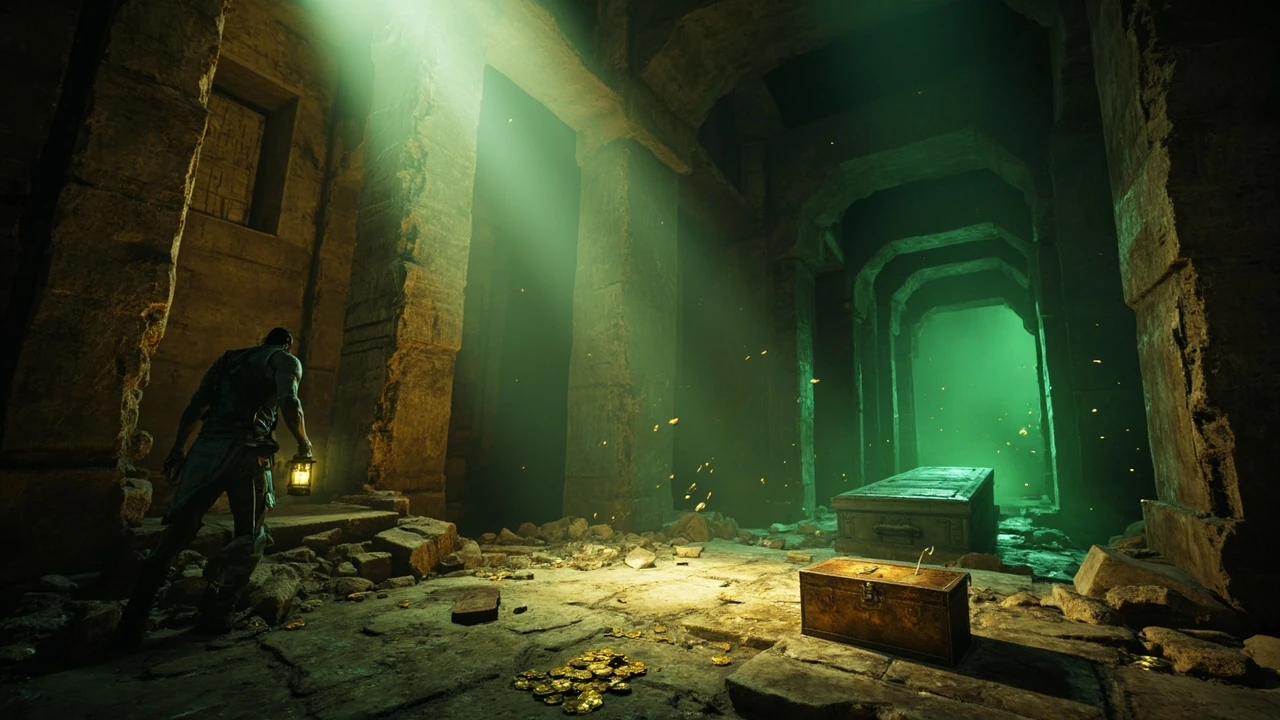
Cursed tomb treasure location
A cursed tomb treasure location is one of the most reliable set pieces in action, adventure, and roguelike games because it lets designers compress a complete experience into a small space. The player arrives, reads the room, takes a calculated risk, escapes with the reward, and carries the memory forward. The reason the formula is so widely imitated is that it teaches several real design skills at once: environmental storytelling, pacing, gating, risk-versus-reward balancing, and the moment-to-moment tension of exploration. When a tomb room fails it usually does so in a predictable way, such as confusing layout, unfair traps, or a reward that feels disconnected from the effort. When a tomb room works, players describe it as a destination, a waypoint, or a memory, which is the strongest signal a level can produce.
This guide approaches the topic from the design side rather than the walkthrough side. The goal is to help level designers, technical artists, and producers reason about the choices that make a cursed tomb feel cursed, that make a treasure feel earned, and that make a location feel like a place rather than a corridor with props dropped on it. The same checklist can be reused for shrines, catacombs, abandoned mines, sunken temples, and any other “risky container of value” that a level designer needs to build.
Why the cursed tomb pattern keeps returning
The cursed tomb has survived every genre shift from text adventures to first-person shooters for a structural reason. It is a closed system with a clear contract. The player is told, through visual and audio cues, that a high-value target is hidden behind a meaningful risk. The space itself usually offers a single dominant reward, a tight set of obstacles, and one or two alternate routes that reward repeat visits. Designers borrow the pattern because it is efficient to author, easy to tutorialize, and forgiving enough to scale from a five-minute side detour to a full chapter of a game.
Equally important, the trope carries cultural shorthand. A cracked stone doorway, dust in torchlight, low brass instrumentation, and a sealed chest already communicate genre and tone before the player reads a single text box. That shorthand is valuable because it lets the design team deliver atmosphere without spending budget on bespoke art for every container. The challenge is to use the shorthand without making every tomb feel like a copy of the last one, and to give the player a different memory of each encounter.
Defining the design contract of a cursed tomb treasure location
Before sketching a layout, a designer should write down the implicit contract a player accepts when entering the space. A useful contract has five elements: a clear value proposition, a visible risk, a perceivable mechanism for mitigating that risk, a payoff that the player can feel, and a small trace that the event happened, such as a journal entry, a scar, a title, or a soft stat change. When any of those five elements is missing, the encounter starts to feel hollow. When all five are present, even a small room feels like an event.
Mapping the contract to level building blocks
- Value proposition: the reward type, magnitude, and what it changes about the player’s future options.
- Visible risk: the trap, enemy, environmental hazard, or story threat that is observable from the entry point.
- Mitigation: the tool, item, mechanic, or skill the player can bring in, including knowledge from earlier in the run.
- Payoff: the moment the player claims the reward, including sound, camera, and a short aftermath beat.
- Trace: the lasting record that the location was cleared, revisited, or failed, which informs later decisions.
The contract is the first thing to put on paper for a cursed tomb treasure location. If a teammate cannot read those five lines on a design document, the level is not ready to enter blockout.
Space planning: shape, scale, and sightlines
Most tomb failures come from bad space planning rather than bad art. A useful tomb reads on a low-information first pass: a single dominant shape with one or two clear sub-rooms, a centerline that the eye can trace, and at least one off-axis pocket that rewards closer attention. Designers should avoid building tombs that are large open arenas with no reading order, and equally avoid tombs that are so cramped that traps and rewards overlap visually. The sweet spot is a room that fits roughly a screen and a half of camera distance, with at least one corner hidden from the entry.
Scale matters because it drives the camera decision. In a third-person game, a tomb that is too wide forces the camera to rotate, which breaks the player’s reading of traps. In a first-person game, a tomb that is too narrow wastes the head bob and weapon sway that build tension. Scale also drives the placement of light sources, which is the most reliable way to lead the player’s eye toward the reward without using UI markers. A single shaft of light on the chest, a flickering torch by the trap plate, and a dim glow on the secondary path are usually enough to communicate the entire contract in the first ten seconds.
Sightline checklist before blockout
- From the entry point, can the player see the reward at least once, partially or fully?
- From the entry point, can the player see at least one trap or threat without dying instantly?
- Is there a visible alternate path that does not require a tooltip to discover?
- Are there at least two light sources doing distinct work, not three lights doing the same job?
- Is the room width compatible with the camera, the player’s movement speed, and the longest-ranged attack in the game?
Risk design: traps, enemies, and curse mechanics
A cursed tomb without meaningful risk is just a storage room. The design question is what kind of risk the location will use and how that risk will be communicated. The classic options are environmental traps, enemy encounters, puzzle gates, narrative cost, and persistent curse effects. Each has a different cost to build, test, and balance, and each supports a different playstyle. Designers should pick one primary risk and one secondary risk rather than stacking every option in the same room.
| Risk type | Player reads as | Build cost | Failure feels like | Best paired with |
|---|---|---|---|---|
| Pressure plate or spike trap | Mechanical, observable | Low | The player’s own mistake | Puzzle gates and exploration rewards |
| Curse status effect | Supernatural, escalating | Medium | Slowing pressure rather than instant death | Loot gambling and risk-versus-reward runs |
| Undead enemy patrol | Combat, readable AI | Medium to high | Skill mismatch | Stealth routes and ammo scarcity |
| Puzzle gate | Logic, knowledge | High | The player missing a clue | Story rewards and progression keys |
| Narrative cost | Story weight | Low to medium | Regret rather than frustration | Endgame or aligned-class content |
The risk table is worth printing next to a level brief because it forces a conversation about what the team is actually asking the player to do. A tomb that uses a puzzle gate, an enemy patrol, and a curse effect all at once usually feels overstuffed, and testing tends to reveal that two of the three mechanics are doing duplicate work. Picking one primary risk also makes QA easier, because the test matrix collapses to a clear set of conditions rather than a combinatorial explosion.
Reward design: what the treasure actually does
Treasure design in a cursed tomb is the most underrated part of the pattern. A chest of gold is a reward in name only if the player already has more gold than they can spend. A powerful weapon is a reward in name only if it does not change how the next fight plays. A useful cursed tomb treasure location changes the player’s decision space in a way that the player can describe in one sentence. Examples include: “this lets me open one locked door I could not open before,” “this removes a specific curse so I can re-enter a previous area,” and “this gives me a tool for a class of puzzle I now expect to see again.”
Designers should write the reward sentence on the design document next to the risk sentence. If the risk is “pressure plates and a curse that drains stamina” and the reward is “a stamina ring that ignores curse drain,” the encounter becomes a teaching tool, because the player learns that future curse-heavy rooms will be easier with that ring. If the risk and the reward do not connect logically, the location turns into a vending machine.
Lighting and atmosphere as level design
Lighting in a tomb is not a polish task. It is a level design tool that communicates room geometry, reward placement, and threat placement at a glance. A useful tomb has one dominant key light, one rim light on the reward, and one or two practical lights that justify a shadow direction. Every additional light should be cut because each one dilutes the player’s reading of the room. Shadow direction is equally important: a trap that is meant to be visible from the entry should cast a shadow toward the player, not away from the player.
External sources also matter when the team needs a sanity check on cultural and historical context. A page such as The Curse of the Mummy’s Tomb on English Wikipedia is a useful reference for the long arc of the cursed tomb in popular culture, and a database page such as the curse of the mummy’s tomb (1964) listing on allmovie is a useful reference for how the trope was staged in a specific work. These references do not replace the team’s own design, but they help the team avoid clichés that have already been done to death and to make deliberate choices about which cliché to keep for the right reason.
Audio carries half the atmosphere of a cursed tomb with a small budget. A low sustained drone, a slow rhythmic percussion that matches the player’s heart rate, and a single metallic sting when the chest opens are usually enough. Designers should treat audio as part of the contract: the same reward sound should not play in a storage crate and a cursed treasure, because the player uses that audio signal to decide what to prioritize.
Navigation and wayfinding without a HUD marker
A well-designed cursed tomb treasure location should be navigable with the game’s natural cues rather than a quest marker. The most reliable non-HUD tools are light contrast, prop scale, color desaturation around the reward, floor material change at the threshold, and a single readable landmark such as a cracked statue or a fallen pillar. Designers often add a quest marker as a safety net, but a marker that points the player straight at the chest removes the entire point of the room, which is the moment of reading the space.
Common wayfinding mistakes to avoid
- Placing the reward in dead center, which removes the player’s sense of discovery.
- Using identical lighting on the entry path and the reward, which makes the room read as uniform.
- Adding a HUD marker on top of an already readable room, which trains the player to ignore environment art.
- Hiding the reward behind a wall in a way that requires a wiki or a video to find.
- Making the alternate route look identical to the main route, so the player cannot tell the difference on a second visit.
Iteration loop: from blockout to shippable
The iteration loop for a tomb is short if the contract is clear. Blockout focuses on space and risk placement. Greybox focuses on sightlines and pacing. Art pass focuses on light and prop placement. Polish focuses on audio and feedback. QA is most useful at the greybox and art stages, when the room can still be re-shaped without re-authoring animations. Skipping QA at the blockout stage usually produces a tomb that looks correct in screenshots but reads wrong in motion, which is the most common cause of “great looking, frustrating to play” feedback.
| Stage | What to test | Common failure | Cheap fix |
|---|---|---|---|
| Blockout | Space, scale, sightlines | Reward invisible from entry | Move light source or reward forward |
| Greybox | Risk readability, pacing | Trap placement feels arbitrary | Add readable tell or adjust timing |
| Art pass | Light contrast, color story | Reward and trap blend together | Push contrast on the reward, not the trap |
| Polish | Audio, feedback, micro-animation | Reward moment lands flat | Tune the chest open sting and camera nudge |
| QA pass | Edge cases, accessibility, performance | Hard for low-vision players to read trap | Add audio tell and a higher-contrast decal |
Each stage has one dominant question. The blockout should answer “can the player see what they need to see.” The greybox should answer “does the player know what to do and why.” The art pass should answer “does the room feel like a place.” The polish should answer “does the reward moment feel earned.” The QA pass should answer “can the intended player clear this room without external help.” A room that passes all five questions is usually ready for certification or release.
Connecting the tomb to the wider game
A cursed tomb treasure location is rarely standalone. It usually connects to a quest, a vendor, a story beat, or a meta-progression system. The most common connection mistake is treating the tomb as a self-contained puzzle and ignoring the rest of the level. A more reliable pattern is to let the tomb teach a mechanic that the player will need in the next two encounters. For example, a tomb that introduces curse-removal items can quietly guarantee that the next dungeon has at least one room that the player can only clear with a cure. This kind of hand-off is what makes a level feel like a chapter rather than a series of disconnected rooms.
For narrative games, the tomb also serves as a story beat. The journal entry that the player finds in the chest, the inscription on the wall, the audio log on a body near the chest, and the visible state of the room all carry story. Designers should treat the room as a paragraph in the larger story, with a clear topic sentence (the room’s contract), supporting details (props and audio), and a closing line (the trace or aftermath). Skipping that structure is how tombs end up feeling like they exist only to gate a chest.
Accessibility, performance, and platform constraints
A cursed tomb is one of the most performance-sensitive spaces in a game because of dynamic light, particles, and complex meshes in a small area. The budget for a single tomb room is usually tighter than the budget for an open area, so designers should keep polycounts and light counts in line with the engine’s hot path. The same room that runs well on a high-end PC can crater a mid-range console if it carries an over-baked lighting solution. The fix is to share light atlases, reuse meshes from a tomb kit, and prefer vertex animation over skeletal animation for moving props.
Accessibility also matters in a tomb because the room is by definition a test. Color-blind players should be able to read the trap, low-vision players should be able to read the reward, and players with motion sensitivity should be able to opt out of the camera shake during the chest-open moment. Audio cues are a cheap way to add accessibility without redesigning the room, and they also benefit players who play with the screen off or in handheld mode on a portable console.
Accessibility checklist for a tomb
- Trap tells include shape and audio, not only color.
- Reward moment has an audio signature distinct from a normal pickup.
- Camera shake, if used, is configurable in the settings menu.
- Subtitles appear for any spoken inscription or audio log.
- Traversal is possible with the game’s default accessibility inputs.
Genre variations on the cursed tomb
While the pattern is shared, the cursed tomb reads differently across genres. In a first-person shooter it tends to lean on enemy density and ammo scarcity, with a chest that grants a powerful but limited weapon. In a survival horror it leans on the slow-burn dread, with a chest that costs the player a permanent resource such as a healing item or a save slot. In a roguelike it leans on risk-versus-reward, with a chest that may carry a curse that the player must weigh against the reward. In an action-adventure it leans on the puzzle, with a chest that opens only when the player has solved a logic gate earlier in the dungeon. Each genre keeps the same five-part contract but redistributes the weight across the elements.
| Genre | Primary risk | Secondary risk | Reward style | Pacing |
|---|---|---|---|---|
| First-person shooter | Enemy density | Ammo scarcity | Limited-use weapon | Fast, punchy |
| Survival horror | Permadeath or save cost | Resource drain | Knowledge or key item | Slow, dread-driven |
| Roguelike | Curse stacking | Path divergence | Gambling-tier item | Run-defining |
| Action-adventure | Puzzle gate | Trap timing | Progression key | Chapter-defining |
| Platformer | Traversal precision | Time pressure | Cosmetic or fast-travel unlock | Skill-check |
This matrix is useful when a team is choosing the genre framing for a new project. A team that wants high replay value usually leans toward the roguelike column. A team that wants a single-player narrative leans toward the survival horror or action-adventure column. A team that wants a session-friendly multiplayer experience usually leans toward the shooter or platformer column. The cursed tomb pattern is flexible enough to support any of those choices, which is why it has survived so many engine transitions.
Player memory and the long tail of a tomb
Designers tend to measure tombs by their internal metrics, such as completion rate, time to clear, and number of player deaths. Those metrics matter, but the more important signal is what the player remembers. A tomb that the player remembers a year later is one that had a clear contract, a clear payoff, and a clear trace. A tomb that the player forgets is one that blended into the rest of the dungeon. The simplest way to make a tomb memorable is to give it one unique detail, such as a specific lighting color, a unique audio motif, or a single prop that no other room in the game uses. The detail does not have to be expensive. A cracked statue of a forgotten god, a small puddle of cursed water, or a single readable inscription can be the entire memory hook.
The trace element is what turns the memory into a story. A tomb that records itself in the player’s journal, in a meta-progression screen, in a save file, or in a small visible scar on the player’s character gives the player a reason to mention the room to other players. That kind of word-of-mouth is the cheapest marketing a level can earn, and it is a stronger signal of design success than any internal metric.
Working with content kits, reuse, and variation
Most studios build tomb rooms from a shared kit of meshes, textures, and audio loops. The kit makes the rooms cheaper to ship, but it also risks making every tomb feel identical. The fix is to vary the kit on three axes: lighting recipe, prop arrangement, and risk layering. A studio that has ten tombs in a region can use three lighting recipes, four prop arrangements, and three risk layers to produce dozens of distinct rooms without a single new asset. The trick is to never repeat the same combination twice in the same region, because the player reads repeated combinations as a copy-paste level.
Reuse also has a quality cost. A kit prop that works at a small scale often looks wrong at a large scale, and a kit light that reads as warm in one room can read as sickly in another. The art director should review the kit’s lighting and prop scales at least once per region to keep the room family consistent. The cheapest time to fix a kit problem is during the kit review, not during a level’s polish pass.
Production and scheduling considerations
A cursed tomb room is a small but expensive asset because of its density. Designers should budget each tomb with an honest cost that includes blockout, greybox, art, audio, animation, lighting, and QA. The most common production mistake is to schedule the room as one task and forget the dependency on audio, which usually slips a week because audio is shared across the region. A more reliable schedule lists the audio and animation tasks as separate items with their own owners, rather than bundling them into a single “tomb room” task that masks the dependency.
Producers should also be cautious about milestone gating. A tomb is a good candidate for a vertical slice because it exercises art, audio, gameplay, and narrative in a small footprint, but it is a poor candidate for a tech demo because the engine work that makes the room feel right often hides the most expensive part of the room, which is the lighting and post-processing. Picking the right milestone for a tomb is part of the production craft.
Common failure modes and how to debug them
When a tomb underperforms in playtesting, the cause is usually one of a small set of predictable failure modes. Designers can use the list below to triage the room before reading through a long playtest report. Each failure mode has a tell, a likely cause, and a cheap test that confirms or rules it out.
Tomb failure triage
- Players do not see the reward. Likely cause: the entry sightline is blocked. Test by re-recording the entry from the default camera and looking for the reward.
- Players do not understand the trap. Likely cause: the trap tell is too subtle or too late. Test by removing all audio and re-running.
- Players do not feel the curse. Likely cause: the curse effect is invisible or too small. Test by doubling the visual intensity and re-running.
- Players feel the reward is unfair. Likely cause: the risk and the reward are mismatched. Test by cutting the reward in half and re-running.
- Players feel the room is too long. Likely cause: the room is sized for a different camera distance. Test by measuring the longest sightline in meters.
- Players feel the room is too short. Likely cause: the room has no breathing space between the trap and the reward. Test by adding a three-second pause beat between the two events.
The triage list is not exhaustive, but it covers the failure modes that account for most of the playtest feedback on a cursed tomb treasure location. Working through the list before reading the full report usually saves a design pass, because the team can rule out the most expensive problems first.
Using existing internal and external references wisely
A team that is building a cursed tomb treasure location should look at a mix of internal references, public references, and cultural references. Internal references are the most reliable because they share the same engine, camera, and player expectations. A studio can use its own game design company guide as a starting point for how the studio frames the contract, scope, and review process. Public references, including films, comics, and museum imagery, are useful for art direction and atmosphere. Designers should keep a small reference folder of tomb art, ranging from real archaeological sites to comic book panels, and tag each image with a single adjective that captures the mood they want.
From a single tomb to a tomb system
Once a studio has shipped a few cursed tomb treasure locations, the design work moves from a single room to a system. A tomb system is a shared set of rules, props, and contracts that lets a small team author many rooms quickly without losing variety. The system usually includes a contract template, a risk palette, a reward palette, a lighting recipe set, an audio palette, and a QA checklist. The system is the studio’s most valuable level design asset, because it captures the lessons the team has learned and lets the next project start further along the design curve.
The system is also the right place to encode accessibility, performance, and platform constraints. When those constraints live in a single shared document, every new tomb inherits them automatically, and the team does not have to re-litigate the same decisions in every design review. The system should be living, with a clear owner who updates it after each shipped project and who keeps a list of “do not repeat” decisions that future projects should respect.
A short checklist before signing off on a tomb
The sign-off moment is the most common place for a tomb to slip through with a hidden flaw. A short checklist that the design lead and the art lead can run in a single meeting is usually enough to catch the worst problems before they reach QA. The checklist below is a starting point. Studios should adapt it to their engine, genre, and audience.
Tomb sign-off checklist
- The five-part contract is written on the design document and reviewed in the meeting.
- The entry sightline shows the reward at least partially and the risk clearly.
- Lighting contrast separates the reward, the trap, and the entry path.
- Audio cues are present for the trap tell, the curse effect, and the reward moment.
- Accessibility cues are present for color-blind, low-vision, and motion-sensitive players.
- Performance budget is verified on the lowest target platform, not only the dev machine.
- Reward connects to a future encounter so the room teaches the player a new tool.
- Trace element is visible in the journal, the save file, or the player’s character.
- One unique memory hook exists in the props, lighting, or audio.
- QA has confirmed the room on the default settings at least once.
Closing notes on building a cursed tomb treasure location
A cursed tomb treasure location is one of the smallest but most expressive spaces in any game. It is also a useful design exercise, because every choice in the room has an outsized effect on the player’s experience. A team that learns to make a tomb that is readable, fair, and memorable will carry those skills into larger levels, and the cursed tomb will quietly continue to do the work it has done for decades, which is to give a player a small, complete story in the time it takes to clear a single room.
Frequently asked questions
What makes a cursed tomb treasure location feel cursed rather than just old?
A tomb feels cursed when the risk is observable, escalating, and tied to a specific mechanic rather than a generic ambient effect. Dust and dim light communicate age; a visible curse drain, a slow debuff, or a patrolling enemy communicates curse. The design should commit to one supernatural mechanic and let it touch every part of the contract, including the trap, the reward moment, and the trace.
How long should a cursed tomb treasure location take to clear?
Most tomb encounters should be completable in three to seven minutes for a first-time player and under two minutes for a repeat visit. The first time should feel paced, with a small read, a small risk, and a clear reward. Repeat visits should feel faster because the player already knows the contract. If the room takes longer than ten minutes for a new player, it is probably trying to do the work of a full dungeon, and the team should split it into smaller rooms.
How many traps should a single tomb room contain?
One primary trap and one secondary trap is usually the right ceiling. The primary trap should be visible from the entry and tied to the room’s main risk. The secondary trap can be tied to the alternate path or to the reward moment. More than two traps tends to make the room read as a gauntlet rather than a tomb, and the player starts to optimize for survival rather than exploration.
Should the reward always be a chest?
No. A chest is the most common container because it is readable across cultures, but the reward can also be a body, a sarcophagus, a sealed door, a shrine, or a non-physical item such as a memory or a title. The choice of container should match the genre, the tone, and the rest of the room. A roguelike can lean on chests, a survival horror can lean on bodies and journals, and an action-adventure can lean on sarcophagi and shrines.
How should a cursed tomb connect to the rest of the level?
The tomb should teach or reinforce a mechanic that the player will need within the next two encounters. The connection can be direct, such as a reward that opens a future door, or indirect, such as a story beat that frames the next chapter. The connection is what turns the tomb from a vending machine into a chapter, and it is the cheapest way to make the room feel like it belongs in the game.
Can a cursed tomb treasure location be reused for different player builds?
Yes, and the design should accommodate that. The contract should be solvable in at least two distinct ways, and the risk should have at least one mitigation that does not require a specific build. Replay value is highest when the room offers a stealth path, a combat path, and a puzzle path, and when the reward shifts slightly based on the path the player chose.
What is the cheapest way to make a tomb memorable without adding new art?
Lighting and audio are the cheapest memory hooks. A unique color temperature, a single shaft of light at the reward, a one-off audio motif, or a small particle effect at the trace element are usually enough. The memory hook does not need to be expensive. It needs to be unique within the region, so the player can describe it in one sentence.
How should designers test a tomb for fairness?
The most reliable fairness test is a clean install with default settings and a first-time player. The designer should watch the player without helping and note every pause, every wrong turn, and every moment of confusion. A second test should run the room on the lowest target platform with default settings, because the lowest platform is where the audio and lighting cues are most likely to break.
Is a cursed tomb a good fit for a vertical slice?
Yes, because a single tomb exercises art, audio, gameplay, and narrative in a small footprint. The slice should include one full room with the contract, the risk, the reward, and the trace element all working. A vertical slice that ships with a working tomb gives the rest of the team a reference for the room’s density, lighting, and audio, and it gives external stakeholders a clear taste of the game’s tone.
What is the biggest mistake teams make with cursed tomb treasure locations?
The biggest mistake is treating the tomb as a container rather than a contract. A team that focuses only on the chest and the trap usually ships a room that looks correct in screenshots but reads wrong in motion. A team that focuses on the contract, including value, risk, mitigation, payoff, and trace, usually ships a room that players remember and recommend. The contract is the design, and the room is the proof.
